The Harpsichord Between Instrument and Interior
Painted soundboards, removable outer cases and later alterations reveal the harpsichord as an instrument whose visual and musical identities were built together.
A harpsichord presents several objects to the eye at once. There is a keyboard within reach of the player, a long case occupying the room, and a broad lid that changes position when opened. Inside, strings and a soundboard establish another field of lines and surfaces. Decoration has to find its place among those parts. Looking closely at historical examples reveals a design problem in which furniture, image and musical mechanism share space without becoming interchangeable.

Girolamo Zenti, Harpsichord, 1666. The Crosby Brown Collection of Musical Instruments, 1889. The Metropolitan Museum of Art. Public Domain, CC0. Collection · CC0 · Image policy
Ten original museum photographs of three harpsichords show overall forms, open and closed cases, soundboard ornament, underside bracing and sculptural supports. Archival black-and-white views are identified in the captions.

Louis Bellot, Harpsichord, 1742. Separate open-lid comparison. The Crosby Brown Collection of Musical Instruments, 1889. The Metropolitan Museum of Art. Public Domain, CC0. Collection · CC0 · Image policy
Ten original museum photographs of three harpsichords show overall forms, open and closed cases, soundboard ornament, underside bracing and sculptural supports. Archival black-and-white views are identified in the captions.
Girolamo Zenti's harpsichord of 1666, in the Metropolitan Museum of Art, makes one distinction particularly clear. Its cypress instrument can be removed from the painted outer case, a construction the museum identifies as typical of Italian harpsichords. An inscription records a restoration by Giovanni Ferrini in 1755, when the keyboard range was extended. The object therefore contains both a physical separation between instrument and enclosure and a historical separation between its first construction and a later musical intervention.
A removable case complicates the idea that decoration merely sits on the surface of an instrument. There can be more than one boundary: the working body and the larger enclosure through which it is presented. From a design perspective, that permits different visual treatments at different distances. The outer silhouette can address a room; the keyboard and internal details address a player. This is a reading of the arrangement, rather than a claim that every Italian maker or patron described the relationship in those terms.

Louis Bellot, Harpsichord, 1742. Underside comparison; does not establish Zenti’s removable-case construction. The Crosby Brown Collection of Musical Instruments, 1889. The Metropolitan Museum of Art. Public Domain, CC0. Collection · CC0 · Image policy
Working body and outer case
Petrus Johannes Couchet's harpsichord of 1669 at the Rijksmuseum brings painted ornament into the instrument itself. The collection record describes flowers, fruit and birds on its soundboard, and a rosette showing a seated harpist with initials. The instrument originally had one keyboard and two sets of strings. In the eighteenth century it acquired a second keyboard, additional keys and another set of strings. Its present appearance therefore combines a decorated historical object with evidence of substantial adaptation for changing musical resources.
The flowers and strings ask for two kinds of looking within the same outline. One follows the painted motifs; the other follows the ordered physical components. Their coexistence is visually striking precisely because neither needs to imitate the other. An image can occupy the intervals around a working structure while remaining recognisable as an image. Describing this arrangement does not establish what the decoration did to the sound. That would require technical evidence specific to the instrument, beyond what its appearance can supply.

Louis Bellot, Harpsichord, 1742. Overhead comparison, distinct from Couchet’s Rijksmuseum instrument. The Crosby Brown Collection of Musical Instruments, 1889. The Metropolitan Museum of Art. Public Domain, CC0. Collection · CC0 · Image policy
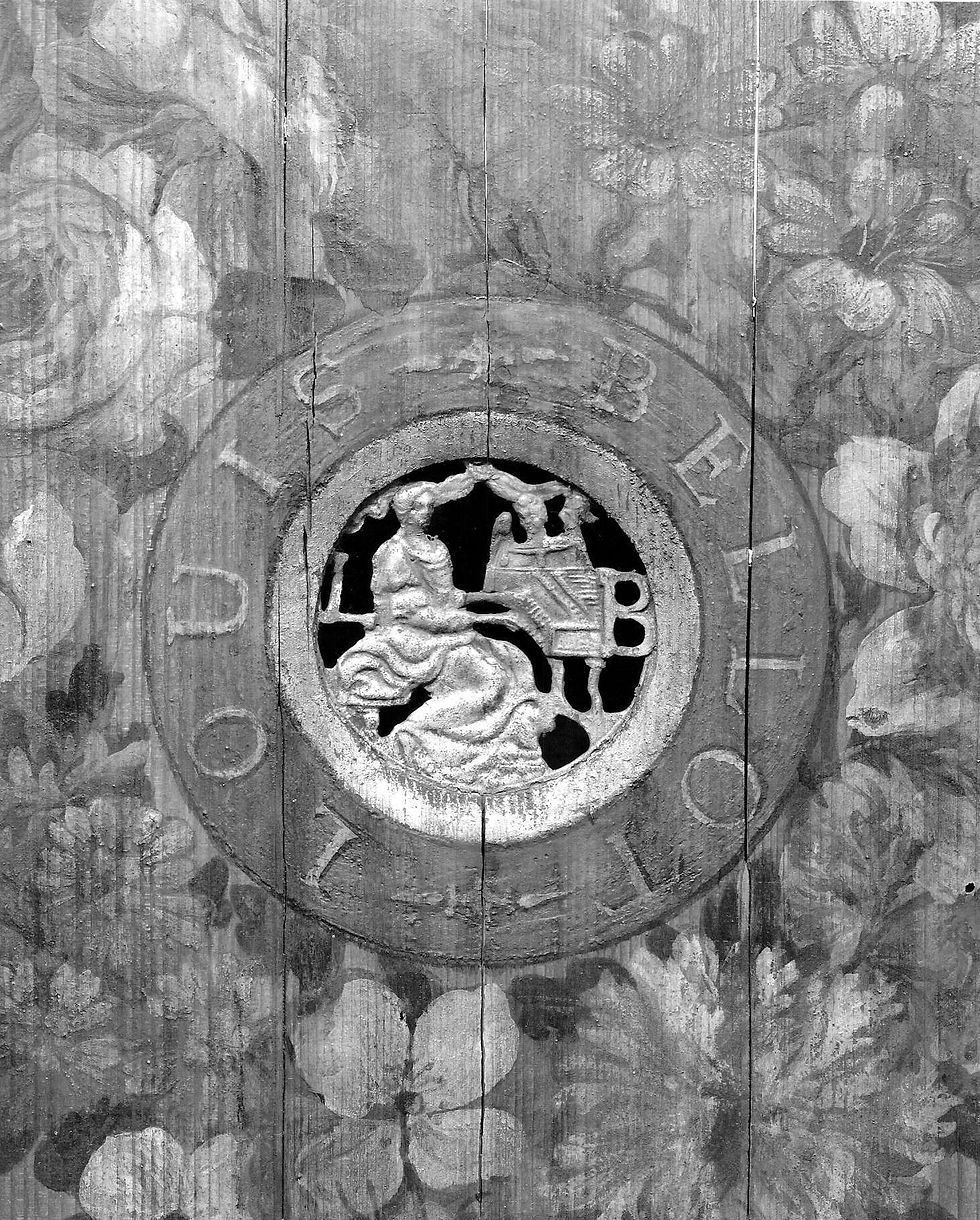
Louis Bellot, Harpsichord, 1742. Rosette detail of Bellot’s instrument, distinct from Couchet’s Rijksmuseum rosette. The Crosby Brown Collection of Musical Instruments, 1889. The Metropolitan Museum of Art. Public Domain, CC0. Collection · CC0 · Image policy
The Met's history of Flemish harpsichords and virginals places such changes in a broader context. It describes eighteenth-century demand for expanded keyboard ranges and tonal possibilities, together with continued esteem for older Antwerp instruments. Rebuilding, known as ravalement, often accompanied redecoration for later tastes. The survival of an early maker's name consequently does not guarantee an unchanged early surface. A present-day view may combine decisions made at different moments, so dates attached to the instrument and to its decorative treatment must be kept distinct.

Louis Bellot, Harpsichord, 1742. Two-keyboard comparison; modification history is not established here. The Crosby Brown Collection of Musical Instruments, 1889. The Metropolitan Museum of Art. Public Domain, CC0. Collection · CC0 · Image policy
The instrument's later life
At the most theatrical end of this relationship stands Michele Todini's Golden Harpsichord, associated with his seventeenth-century Galleria Armonica in Rome. The Met's account describes the instrument within an elaborate gilded ensemble of marine figures and the story of Polyphemus and Galatea. It also documents important uncertainties about the original arrangement and a lost mechanism intended to imitate a bagpipe. Those gaps matter. The surviving sculpture supports discussion of the ensemble's visual ambition without proving that every reported mechanical effect worked as described.

Michele Todini, Harpsichord, ca. 1670. Original ensemble arrangement and lost mechanism remain uncertain. The Crosby Brown Collection of Musical Instruments, 1889. The Metropolitan Museum of Art. Public Domain, CC0. Collection · CC0 · Image policy

Michele Todini, Harpsichord, ca. 1670. Supporting-figure detail of the same Todini ensemble. The Crosby Brown Collection of Musical Instruments, 1889. The Metropolitan Museum of Art. Public Domain, CC0. Collection · CC0 · Image policy
Todini's ensemble makes an extreme case for thinking beyond the lid as a convenient picture frame. Figures, supporting forms and relief decoration extend the instrument into its surroundings. In more restrained examples, the same question remains at a smaller scale: what does the instrument show when closed, and what becomes visible when it is ready to play? An open lid changes the balance of horizontal and upright surfaces. The object can reorganise its own visual presence before a note is heard.

Louis Bellot, Harpsichord, 1742. Closed side view of the same Bellot instrument. The Crosby Brown Collection of Musical Instruments, 1889. The Metropolitan Museum of Art. Public Domain, CC0. Collection · CC0 · Image policy

Louis Bellot, Harpsichord, 1742. Open side view of the same Bellot instrument. The Crosby Brown Collection of Musical Instruments, 1889. The Metropolitan Museum of Art. Public Domain, CC0. Collection · CC0 · Image policy
The harpsichord's design history is consequently a history of coordinated parts and successive decisions. A case might be removable, a soundboard painted, a keyboard enlarged, or an older instrument given a newer exterior. None of those facts makes visual design incidental. They show why it must be read with the construction and the object's subsequent life. To look well at a harpsichord is to keep its surfaces in conversation with its mechanism, while recognising that their histories may not be exactly the same.


Comments