How Katagami Made a Pattern Work
Japanese paper stencils reveal how a textile pattern was engineered for repetition, dye, and the changing orientation of a garment.
A river can run in two directions on a piece of cloth. In a nineteenth-century Japanese stencil at the Metropolitan Museum of Art, bush clover gathers beside a meandering stream, yet the landscape refuses to settle into a single upright view. The museum explains why: a traditional garment without a shoulder seam needs its pattern to read coherently on both front and back. That small accommodation offers a precise way into katagami, the carved paper stencils used to pattern textiles. Here, pictorial composition is already thinking about construction.

Stencil for Textile with Pattern of Bush Clover and Meandering Stream, 19th century. The Metropolitan Museum of Art. Gift of Mrs. Horace Havemeyer, 1942. CC0 1.0. Collection · CC0 · Image policy
Ten historical paper stencils from The Metropolitan Museum of Art, photographed as collection objects. These images show the tools themselves, rather than contemporary dyeing demonstrations.
The surviving stencil is a working object with several obligations. It must hold a design together, admit paste through selected openings, and permit the dyer to repeat that design across a larger surface. Displayed flat in a museum, it can resemble a self-contained graphic work. Its real complexity emerges when we imagine the next placement, the eventual dye bath, and the cloth turning around a body.

Stencil, 19th century. Lattice-and-flower comparison. The Metropolitan Museum of Art. Gift of Mrs. Horace Havemeyer, 1942. CC0 1.0. Collection · CC0 · Image policy
Paper, paste and negative space
The material begins with a practical transformation. Cooper Hewitt describes mulberry-bark paper treated with fermented persimmon juice to make it strong, flexible, and resistant to water. Thin silk threads can reinforce the cut pattern. These supports allow the maker to remove more paper without losing the connections that keep the design usable. The visible image and its supporting structure become separate but interdependent arrangements.

Stencil, 19th century. Fine-line comparison; original paper and silk. The Metropolitan Museum of Art. Gift of Mrs. Horace Havemeyer, 1942. CC0 1.0. Collection · CC0 · Image policy
That division is especially clear in the Met's Stencil with Pattern of Parallel, Undulating Lines, catalogued as paper reinforced with silk. The lines generate movement through repetition, while the reinforcement supports a sheet increasingly defined by what has been cut away. Read as design, the object asks a surprisingly exact question: how little visible structure can hold a complex image in place? The answer is present in the material, rather than supplied by an ornamental frame.

Stencil with Pattern of Parallel, Undulating Lines, 19th century. The Metropolitan Museum of Art. Gift of Mrs. Horace Havemeyer, 1942. CC0 1.0. Collection · CC0 · Image policy

Stencil, 19th century. Separate fine-line-and-band comparison. The Metropolitan Museum of Art. Gift of Mrs. Horace Havemeyer, 1942. CC0 1.0. Collection · CC0 · Image policy
To understand the resulting textile, the viewer must also reverse an instinct. Cooper Hewitt's account of a historical dyer's workshop describes rice-paste resist pushed through the stencil with a wooden spatula. Those covered areas are protected during dyeing; the stencil is moved repeatedly along the fabric. The openings therefore determine where colour will be withheld. A stencil carries an instruction for a later image, including the spaces that will remain uncoloured.
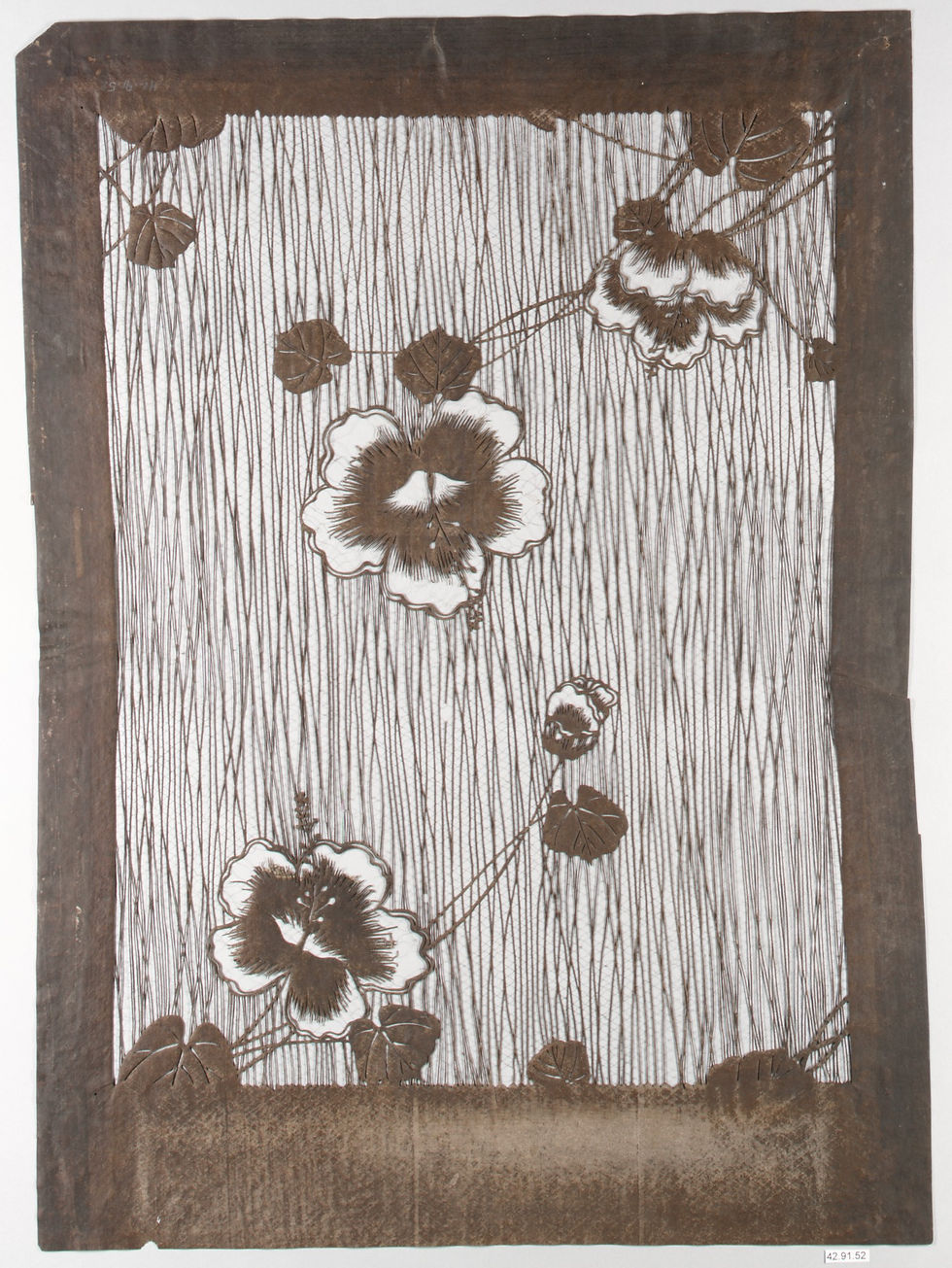
Stencil, 19th century. Flower-and-line comparison; a stencil, not finished cloth. The Metropolitan Museum of Art. Gift of Mrs. Horace Havemeyer, 1942. CC0 1.0. Collection · CC0 · Image policy
A pattern that has to move
The Met's Seascape on White Ground makes that relationship particularly legible. Its record identifies the stencil as jishiro, or white ground: the background is cut away so that resist protects it, leaving a dyed motif against the reserved cloth. Half the composition is oriented one way and half the other. The sea scene has been organized for a textile that can be approached from either end. Its apparent decorative freedom depends on disciplined decisions about reversal and use.

Stencil with Pattern of Seascape on White Ground, 19th century. The Metropolitan Museum of Art. Gift of Mrs. Horace Havemeyer, 1942. CC0 1.0. Collection · CC0 · Image policy
Repetition also gives different kinds of imagery a common working format. A continuous fret pattern, or sayagata, produces an interlocking geometric field. The Met traces this pattern to China and notes its widespread appearance in Japanese dress during the Edo period. Another stencil, Maple Leaves on Water, invokes the Tatsuta River and its poetic association with autumn foliage. One design proceeds through geometric continuity; the other carries a recognizable seasonal reference. Both must become repeatable surfaces.

Stencil with Continuous Fret Pattern (sayagata), 19th century. The Metropolitan Museum of Art. Fletcher Fund, 1937. CC0 1.0. Collection · CC0 · Image policy

Stencil with Pattern of Maple Leaves on Water, 19th century. The Metropolitan Museum of Art. Gift of Mrs. Horace Havemeyer, 1942. CC0 1.0. Collection · CC0 · Image policy
For a contemporary designer looking at these sheets, the useful comparison is with the making of a repeat, rather than with a finished swatch. Where does a line leave the edge? What meets it at the next impression? Which shapes remain convincing when the cloth folds or changes orientation? These are analytical questions prompted by the objects, not claims that their makers anticipated digital design. Katagami supplies its own historical answers through paper, thread, cutting, and the dyer's handling.

Stencil with Pattern of Open Flowers on Water, 19th century. Related historical stencil; distinct from the 2013 peacock recreation. The Metropolitan Museum of Art. Gift of Mrs. Horace Havemeyer, 1942. CC0 1.0. Collection · CC0 · Image policy
The work inside a reusable tool
The division of labour matters, too. At a 2013 Cooper Hewitt demonstration, carver Isao Uchida recreated a peacock stencil from the museum's collection, and dyer Masao Aida used it in a textile demonstration. The museum reported that Uchida spent three days carving that single stencil before the event. Even one repeat could embody substantial preparation before the dyeing began. Reusability concentrated work in a tool whose value would unfold through subsequent applications.
Katagami rewards a change in viewing distance. From across a room, we read waves, flowers, or a field of fine lines. Close up, we encounter the fragile bridges and reinforcing threads that make those effects possible. The garment-scale and paper-scale views belong together. These stencils offer a history of surface design in which beauty is inseparable from sequence: making a sheet, cutting an opening, placing a repeat, reserving a colour, and allowing the final pattern to move.
The objects in detail
Ten historical paper stencils from The Metropolitan Museum of Art, photographed as collection objects. These images show the tools themselves, rather than contemporary dyeing demonstrations.
1. Stencil for Textile with Pattern of Bush Clover and Meandering Stream, 19th century. Paper reinforced with silk. The Metropolitan Museum of Art, Gift of Mrs. Horace Havemeyer, 1942 (42.91.225). Image: The Metropolitan Museum of Art, CC0. CC0 licence.
2. Stencil with Pattern of Seascape on White Ground, 19th century. Paper, silk. The Metropolitan Museum of Art, Gift of Mrs. Horace Havemeyer, 1942 (42.91.16). Image: The Metropolitan Museum of Art, CC0. CC0 licence.
3. Stencil with Pattern of Maple Leaves on Water, 19th century. Paper reinforced with silk. The Metropolitan Museum of Art, Gift of Mrs. Horace Havemeyer, 1942 (42.91.14). Image: The Metropolitan Museum of Art, CC0. CC0 licence.
4. Stencil with Pattern of Parallel, Undulating Lines, 19th century. Paper reinforced with silk. The Metropolitan Museum of Art, Gift of Mrs. Horace Havemeyer, 1942 (42.91.188). Image: The Metropolitan Museum of Art, CC0. CC0 licence.
5. Stencil with Pattern of Open Flowers on Water, 19th century. Paper reinforced with silk. The Metropolitan Museum of Art, Gift of Mrs. Horace Havemeyer, 1942 (42.91.77). Image: The Metropolitan Museum of Art, CC0. CC0 licence.
6. Stencil with Continuous Fret Pattern (sayagata), 19th century. Paper. The Metropolitan Museum of Art, Fletcher Fund, 1937 (37.14.45). Image: The Metropolitan Museum of Art, CC0. CC0 licence.
7. Stencil, 19th century. Paper. The Metropolitan Museum of Art, Gift of Mrs. Horace Havemeyer, 1942 (42.91.194). Image: The Metropolitan Museum of Art, CC0. CC0 licence.
8. Stencil, 19th century. Paper, silk. The Metropolitan Museum of Art, Gift of Mrs. Horace Havemeyer, 1942 (42.91.213). Image: The Metropolitan Museum of Art, CC0. CC0 licence.
9. Stencil, 19th century. Paper, silk. The Metropolitan Museum of Art, Gift of Mrs. Horace Havemeyer, 1942 (42.91.52). Image: The Metropolitan Museum of Art, CC0. CC0 licence.
10. Stencil, 19th century. Paper, silk. The Metropolitan Museum of Art, Gift of Mrs. Horace Havemeyer, 1942 (42.91.184). Image: The Metropolitan Museum of Art, CC0. CC0 licence.


Comments