How Iznik Ceramics Give Colour a Job
Cobalt blue, raised red and carefully shaped white spaces turn Iznik pottery into a study of how ornament works across dishes, vessels and tiled walls.
A flower on an Iznik dish has several jobs. It can be a recognizable bloom, a patch of saturated colour and a line that pulls the eye across a curved surface. On the Metropolitan Museum of Art’s late-sixteenth-century dish with two birds, carnations, tulips and hyacinths occupy the same shallow space. Read as a design composition, the crowded garden offers a useful introduction to Iznik: its exuberance depends on careful organization.

Dish Depicting Two Birds among Flowering Plants, ca. 1575–90. The Metropolitan Museum of Art, Gift of James J. Rorimer in appreciation of Maurice S. Dimand's curatorship, 1933–1959, 1959. Public Domain / CC0. Collection · CC0 · Image policy
Ten photographed Iznik ceramic objects in The Metropolitan Museum of Art collection, with individual dates and attributions retained in the captions.

Dish with Sailing-ship Design, ca. 1600. Separate ship-composition comparison. The Metropolitan Museum of Art, Harris Brisbane Dick Fund, 1966. Public Domain / CC0. Collection · CC0 · Image policy
Ten photographed Iznik ceramic objects in The Metropolitan Museum of Art collection, with individual dates and attributions retained in the captions.
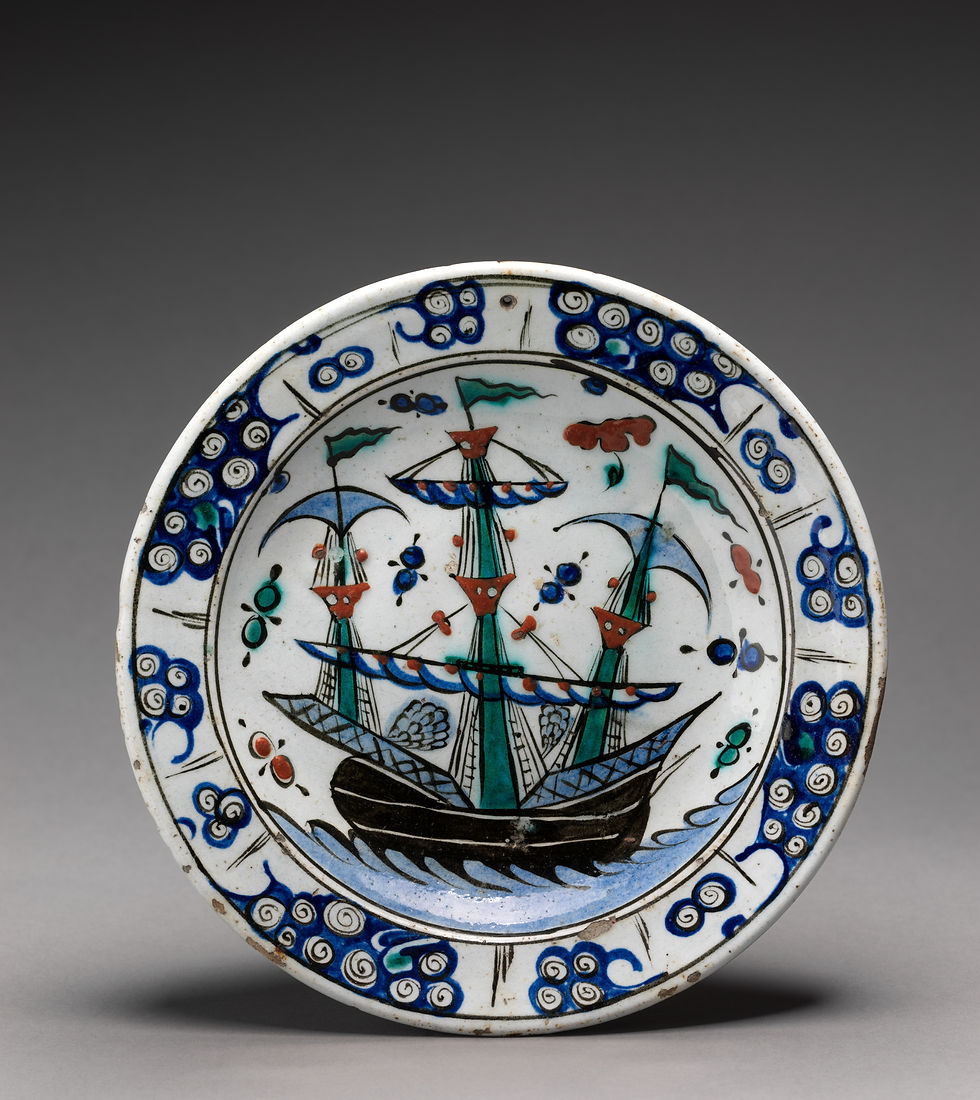
Dish with Sailing-Ship Design, 17th century. Another ship-composition comparison. The Metropolitan Museum of Art, Harris Brisbane Dick Fund, 1966. Public Domain / CC0. Collection · CC0 · Image policy
Ten photographed Iznik ceramic objects in The Metropolitan Museum of Art collection, with individual dates and attributions retained in the captions.
The palette helped establish that organization. In the Met’s account, Iznik ceramics began by engaging with Chinese blue-and-white porcelain, then expanded through turquoise and black outlines to a fuller range of colours during the 1550s and 1560s. Cobalt could produce both deep blue and paler passages. The resulting flowers need not dissolve into a single ornamental mass. Dark outlines separate their silhouettes; changes of blue give neighbouring areas different visual weight. This is one way to understand the decoration’s clarity, rather than treating every colour as an equally loud accent.

Dish, mid-16th century. Turquoise-and-blue palette comparison. The Metropolitan Museum of Art, Bequest of Benjamin Altman, 1913. Public Domain / CC0. Collection · CC0 · Image policy
Changing the relationship of figure and ground
Chinese models remained active sources even after this expansion. A footed dish dated about 1570–80 reproduces the floral scrolls, lobed rim and blue palette of a fifteenth-century Chinese prototype. The Met identifies its raised foot as an apparently Ottoman addition. That small change matters to the design argument. A pattern can travel while the object carrying it changes its stance. The foot lifts the decorated bowl into a different relationship with the supporting surface, making its profile part of the encounter.

Footed Dish with Foliate Rim in Imitation of Chinese Porcelain, ca. 1570–80. Raised foot apparently an Ottoman addition. The Metropolitan Museum of Art, Harris Brisbane Dick Fund, 1966. Public Domain / CC0. Collection · CC0 · Image policy
The familiar white field was itself a material decision. Most Iznik wares received a white slip before decoration, according to the Met’s entry for a blue-ground dish of about 1570–75. Some makers coloured that preparation, producing backgrounds including blue, pink and brown. On this example, white and red lines articulate a radial pattern on the blue field. The shift invites a different reading of figure and ground: light outlines separate areas of colour. White is therefore an active component of the design, with its own shape and distribution.

Blue-ground Dish with Floral and 'Cintamani' Designs, ca. 1570–75. The Metropolitan Museum of Art, The Friends of the Department of Islamic Art Fund, 1970. Public Domain / CC0. Collection · CC0 · Image policy

Blue-Ground Dish with Floral Design, ca. 1550–60. Earlier blue-ground comparison. The Metropolitan Museum of Art, Bequest of Benjamin Altman, 1913. Public Domain / CC0. Collection · CC0 · Image policy
Colour describes a volume
Red introduced another kind of presence. Cleveland Museum of Art explains that Iznik potters achieved it with an iron-rich clay slip. Its Gilded Dish with Flowers and Leaves, dated about 1590, combines red roses with blue hyacinths around a curving, serrated saz leaf. Surviving gold further complicates the surface. My reading is that the red punctuates the floral movement while the large leaf establishes its direction. The Chinese-derived rock-and-wave border supplies a separate rhythm around the edge, containing the more expansive activity inside.
Colour could also describe a vessel’s construction. On the Met’s late-sixteenth-century mosque lamp, red is applied in relief, and a narrow red band marks the transition between body and neck. Blue and red saz ornament interlace across the body. Here, decoration makes the changing volume easier to follow. The museum notes the shape’s relationship to metal lanterns and cautions that ceramic lamps of this kind were probably suspended as interior furnishings rather than used for illumination. A familiar silhouette could acquire a different material and purpose.

Mosque Lamp, late 16th century. Probably an interior furnishing rather than a working light. The Metropolitan Museum of Art, Bequest of Benjamin Altman, 1913. Public Domain / CC0. Collection · CC0 · Image policy
Design across media
Court design extended these relationships into architecture. The Met’s teaching resource describes a tile of about 1578 associated with the renovation of Sultan Murad III’s private quarters. Designs were developed in the imperial workshop in Istanbul and executed in Iznik. Motifs interrupted by the tile’s edges become complete when matching units meet. The design operates across joints: a single ceramic square is only one part of the intended view. Red cloud bands, blue and green ornament, and white ground become elements in a larger, repeatable composition.

Tile with 'Saz' Leaf Design, ca. 1545–55. Earlier comparison, distinct from Murad III’s ca. 1578 tile. The Metropolitan Museum of Art, Gift of Richard Ettinghausen, 1978. Public Domain / CC0. Collection · CC0 · Image policy
An earlier Met vessel, dated 1525–40, offers another route between media. Its form follows glass mosque lamps, while its fine spiralling decoration is compared with the vines in illuminated imperial signatures, or tughras. This helps explain the breadth of Iznik’s design resources. A potter could work with the silhouette of glass, the ornament of manuscript illumination and the precedent of imported porcelain without producing a literal copy of any one object.

Ceramic Vessel in the Shape of a Mosque Lamp, 1525–40. The Metropolitan Museum of Art, Harris Brisbane Dick Fund, 1959. Public Domain / CC0. Collection · CC0 · Image policy
Seen together, these pieces suggest a practical way to look at Iznik ceramics. Follow what a colour does at the rim, where a stem changes direction, or where a motif crosses an architectural joint. The beauty rests partly in those negotiations between surface and shape. Cobalt, red and white gain force through their placement, allowing a shared ornamental vocabulary to remain legible across objects with very different dimensions and uses.
The objects in detail
Ten photographed Iznik ceramic objects in The Metropolitan Museum of Art collection, with individual dates and attributions retained in the captions.
1. Dish Depicting Two Birds among Flowering Plants, ca. 1575–90. Stonepaste; polychrome painted under transparent glaze. The Metropolitan Museum of Art, Gift of James J. Rorimer in appreciation of Maurice S. Dimand's curatorship, 1933–1959, 1959 (59.69.1). Public Domain / CC0. CC0 licence.
2. Footed Dish with Foliate Rim in Imitation of Chinese Porcelain, ca. 1570–80. Stonepaste; polychrome painted in blue under transparent glaze. The Metropolitan Museum of Art, Harris Brisbane Dick Fund, 1966 (66.4.2). Public Domain / CC0. CC0 licence.
3. Blue-ground Dish with Floral and 'Cintamani' Designs, ca. 1570–75. Stonepaste; colored slip and polychrome painted. The Metropolitan Museum of Art, The Friends of the Department of Islamic Art Fund, 1970 (1970.30). Public Domain / CC0. CC0 licence.
4. Dish with Sailing-ship Design, ca. 1600. Stonepaste; polychrome painted under transparent glaze. The Metropolitan Museum of Art, Harris Brisbane Dick Fund, 1966 (66.4.7). Public Domain / CC0. CC0 licence.
5. Dish with Sailing-Ship Design, 17th century. Stonepaste; polychrome painted under transparent glaze. The Metropolitan Museum of Art, Harris Brisbane Dick Fund, 1966 (66.4.4). Public Domain / CC0. CC0 licence.
6. Tile with 'Saz' Leaf Design, ca. 1545–55. Stonepaste; polychrome painted under transparent glaze. The Metropolitan Museum of Art, Gift of Richard Ettinghausen, 1978 (1978.350). Public Domain / CC0. CC0 licence.
7. Mosque Lamp, late 16th century. Stonepaste; painted and glazed. The Metropolitan Museum of Art, Bequest of Benjamin Altman, 1913 (14.40.731). Public Domain / CC0. CC0 licence.
8. Ceramic Vessel in the Shape of a Mosque Lamp, 1525–40. Stonepaste; painted in blue under transparent glaze. The Metropolitan Museum of Art, Harris Brisbane Dick Fund, 1959 (59.69.3). Public Domain / CC0. CC0 licence.
9. Dish, mid-16th century. Stonepaste; painted in turquoise and two hues of blue under transparent glaze. The Metropolitan Museum of Art, Bequest of Benjamin Altman, 1913 (14.40.727). Public Domain / CC0. CC0 licence.
10. Blue-Ground Dish with Floral Design, ca. 1550–60. Stonepaste; polychrome painted under transparent glaze. The Metropolitan Museum of Art, Bequest of Benjamin Altman, 1913 (14.40.732). Public Domain / CC0. CC0 licence.


Comments