The Folding Fan as a Portable Picture
A pivot, a pleated leaf, and two protective guards made the folding fan an image that could change shape in the hand.
A mid-eighteenth-century Italian fan in the Metropolitan Museum of Art carries the Finding of Romulus and Remus across a paper leaf painted in gouache and bronze paint. Beneath the scene, carved and pierced tortoiseshell sticks are enriched with metal leaf; the pivot is finished with a clear paste jewel. Even the joint has a visual role. The object brings an expansive picture and an intricate support into a single, hand-sized mechanism. Its image can be displayed, angled towards another person, or folded away.

Italian folding fan with The Finding of Romulus and Remus, mid-eighteenth century. The painted paper leaf is mounted on carved and pierced tortoiseshell sticks. Image: The Metropolitan Museum of Art. Robert Lehman Collection, 1975. Public Domain (CC0).
The architecture is economical. Rigid sticks rotate around a pin, while their upper sections support a pleated leaf. The outer sticks, called guards, protect the closed fan and are generally heavier than the internal supports. Some fans sandwich the ribs between two leaves; others leave them visible on the reverse. The Royal Collection Trust's guide distinguishes these arrangements and notes that decoration on the edges of certain ivory sticks becomes visible only when the fan is shut. Closing can reveal a second design rather than simply ending the display.
A picture designed to fold
That movement gives the painter an unusual commission. The usable field is curved, interrupted by pleats, and repeatedly compressed. Looking at the Romulus and Remus fan as a design object means keeping those conditions in view: the picture occupies a surface with a built-in sequence of ridges and valleys. Its supporting sticks also converge below the painted scene. The eye travels across the narrative while the structure draws attention towards the hand. A rectangular frame could not create quite the same relationship between picture, support, and gesture.
An Italian fan dated around 1815 makes the two-sided format especially vivid. It represents the 1806 eruption of Mount Vesuvius on parchment mounted on mother-of-pearl sticks with spangles. The Met describes views from opposite positions: across the bay on one side, and from a hillside on the other. The owner could turn the fan to change the viewpoint. As a portable object, it allowed a dramatic landscape to be held at intimate scale, with the reflective mounting adding a separate material presence around the painted event.
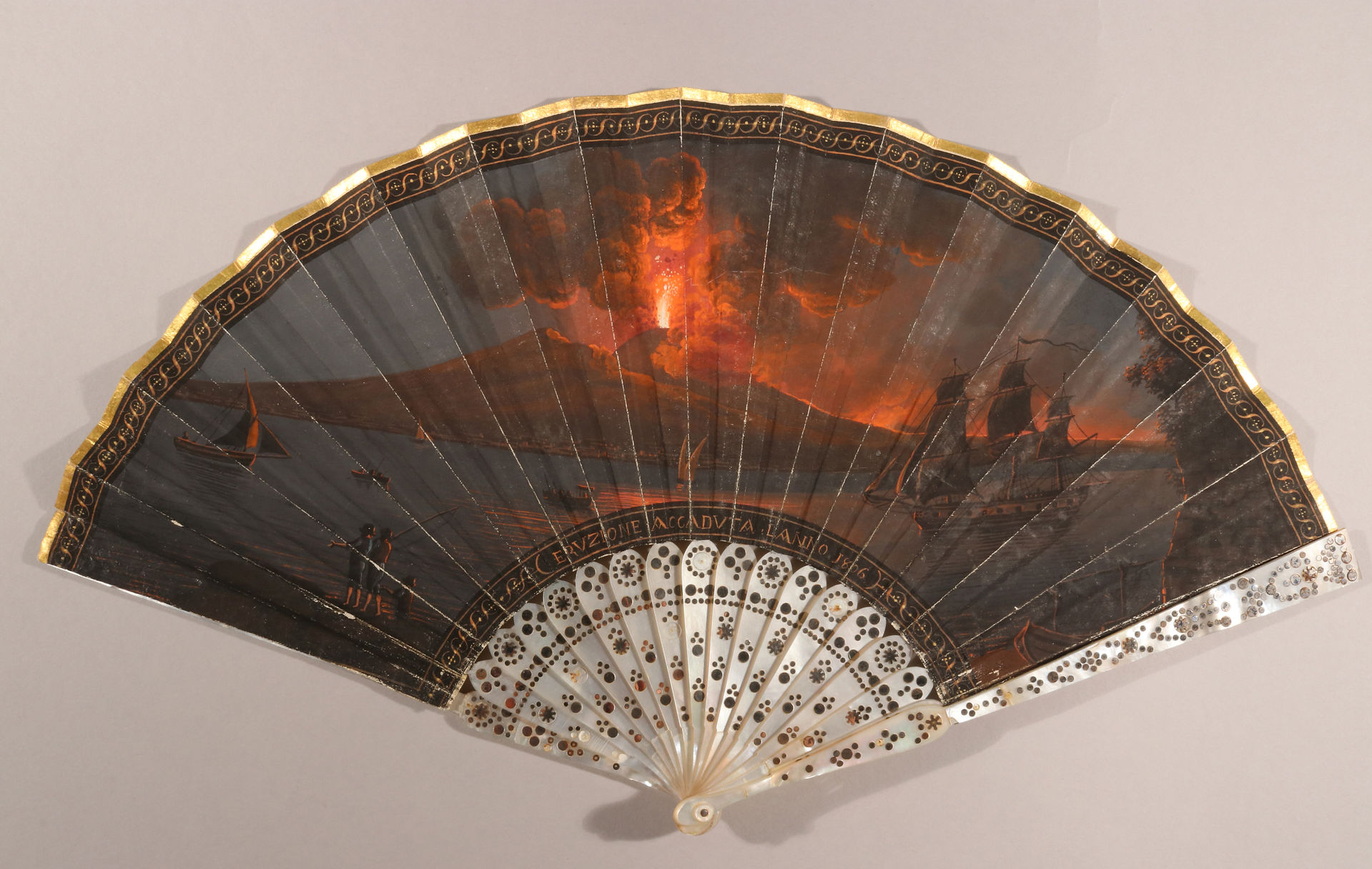
Italian fan, ca. 1815, depicting the 1806 eruption of Mount Vesuvius. This view shows the bay scene on the pleated parchment leaf above mother-of-pearl sticks. Photograph: Denny Stone, The Metropolitan Museum of Art. Bequest of Mrs. George Clinton Genet, 1914. Public Domain (CC0). 
Reverse of the Italian Vesuvius fan, ca. 1815. The hillside view of the 1806 eruption contrasts with the bay scene on the other side. Photograph: Denny Stone, The Metropolitan Museum of Art. Bequest of Mrs. George Clinton Genet, 1914 (14.73). Public Domain (CC0).
Not every surviving fan-shaped picture completed that transformation. The Met documents unmounted leaves bought by travelers, probably with the intention of attaching them to sticks after returning home; some remained flat. This matters when comparing collections. A fan leaf and a functioning fan may share an outline, but their practical demands differ. The mounted version has to reconcile the image with joints, supports, and folds. An unmounted example lets us study the composition without that apparatus, while leaving open whether its intended assembly ever happened.
The fan as an information surface
A fan commemorating the 1855 Universal Exhibition demonstrates how much information the format could carry. After a design by Alphonse Guilletat, it combines a hand-colored and gilded lithograph with ivory and mother-of-pearl. The museum's account identifies the Palais de l'Industrie on one side and the Galerie des Machines on the other, together with French and English text comparing the Paris buildings with London's Crystal Palace. Here the spread is also an information surface. Buildings and statistics have to fit a field that narrows towards the hand and disappears into a stack when closed.

Fan commemorating the 1855 Universal Exhibition, after Alphonse Guilletat and printed by Brioude-Laguérie. A hand-colored and gilded lithograph spans the mounted fan leaf. Image: The Metropolitan Museum of Art. Gift of Mrs. Thomas Hunt, 1933. Public Domain (CC0). 
Reverse of the fan commemorating the 1855 Universal Exhibition, after Alphonse Guilletat and printed by Brioude-Laguérie. The Galerie des Machines and French and English text occupy this side of the pleated leaf. Image: The Metropolitan Museum of Art. Gift of Mrs. Thomas Hunt, 1933 (33.82.14). Public Domain (CC0).
Different materials changed the balance between that surface and its frame. A French example from around 1774–93 combines silk, ivory, and spangles; a nineteenth-century Chinese export fan with figures in a courtyard garden is catalogued simply as paper and wood. These records describe different constructions, rather than a single luxury formula. Another Chinese export fan depicts fans and scrolls across its own leaf. The self-reference is apt: the object makes its own cultural identity part of the image it carries.

French folding fan, ca. 1774–93, made with silk, ivory and spangles. Its open structure offers a material contrast with the paper-and-wood export fan. Image: The Metropolitan Museum of Art. Bequest of Mary Clark Thompson, 1923. Public Domain (CC0). 
Chinese folding fan made for the European market, nineteenth century. The front shows figures in a courtyard garden above decorated wooden sticks. Image: The Metropolitan Museum of Art. Gift of Laurent Oppenheim Jr., in memory of Laurent and Amy Oppenheim, 1964. Public Domain (CC0).
The same moving parts that make these objects compelling also make them vulnerable. The Met's handling guidance warns that repeated opening and closing can cause wear, pigment loss, and other damage; historic fans should not be operated without knowledgeable guidance. A museum display therefore preserves only one of their possible states. Reading a folding fan closely requires imagining the transitions without testing them: the guard passing over the leaf, the picture breaking into pleats, and a broad visual field returning to the dimensions of the hand. That capacity to gather an image into a small volume remains the fan's most persuasive design achievement.
Sources
Image credits and licensing
Image: The Metropolitan Museum of Art. Robert Lehman Collection, 1975. Public Domain (CC0). Source: https://www.metmuseum.org/art/collection/search/460417 . License: https://creativecommons.org/publicdomain/zero/1.0/ . Museum Open Access policy: https://www.metmuseum.org/hubs/open-access . Original photograph reproduced without alteration.
Photograph: Denny Stone, The Metropolitan Museum of Art. Bequest of Mrs. George Clinton Genet, 1914. Public Domain (CC0). Source: https://www.metmuseum.org/art/collection/search/209476 . License: https://creativecommons.org/publicdomain/zero/1.0/ . Museum Open Access policy: https://www.metmuseum.org/hubs/open-access . Original photograph reproduced without alteration.
Image: The Metropolitan Museum of Art. Gift of Mrs. Thomas Hunt, 1933. Public Domain (CC0). Source: https://www.metmuseum.org/art/collection/search/197357 . License: https://creativecommons.org/publicdomain/zero/1.0/ . Museum Open Access policy: https://www.metmuseum.org/hubs/open-access . Original photograph reproduced without alteration.
Image: The Metropolitan Museum of Art. Bequest of Mary Clark Thompson, 1923. Public Domain (CC0). Source: https://www.metmuseum.org/art/collection/search/209504 . License: https://creativecommons.org/publicdomain/zero/1.0/ . Museum Open Access policy: https://www.metmuseum.org/hubs/open-access . Original photograph reproduced without alteration.
Image: The Metropolitan Museum of Art. Gift of Laurent Oppenheim Jr., in memory of Laurent and Amy Oppenheim, 1964. Public Domain (CC0). Source: https://www.metmuseum.org/art/collection/search/209911 . License: https://creativecommons.org/publicdomain/zero/1.0/ . Museum Open Access policy: https://www.metmuseum.org/hubs/open-access . Original photograph reproduced without alteration.
Photograph: Denny Stone, The Metropolitan Museum of Art. Bequest of Mrs. George Clinton Genet, 1914 (14.73). Public Domain (CC0). Source: https://www.metmuseum.org/art/collection/search/209476 . License: https://creativecommons.org/publicdomain/zero/1.0/ . Museum Open Access policy: https://www.metmuseum.org/hubs/open-access . Original photograph reproduced without alteration.
Image: The Metropolitan Museum of Art. Gift of Mrs. Thomas Hunt, 1933 (33.82.14). Public Domain (CC0). Source: https://www.metmuseum.org/art/collection/search/197357 . License: https://creativecommons.org/publicdomain/zero/1.0/ . Museum Open Access policy: https://www.metmuseum.org/hubs/open-access . Integral photograph; decoded pixels and dimensions preserved.


Comments