Holding a Fragrance: The Design of Jewish Spice Containers
From pierced towers to a hinged silver fish, Havdalah spice containers bring form, handling and fragrance together within a specific ritual tradition.
A container normally keeps its contents apart from the surrounding world. A spice container used for Havdalah has a more particular task: it holds aromatic material while allowing its fragrance to be encountered. That gives openings, lids and the relation to the hand an unusual importance. The silver towers and animal forms preserved in museum collections are compelling small objects, but their design becomes more intelligible when approached through the Jewish ritual for which they were made.

Fish-form spice container (Besamim), 1813. Side view. Purchase, Manda and Albert Kalimian Gift, in honor of Sabrina and Daniel Kalimian, 2025. The Metropolitan Museum of Art. Public Domain, CC0. Collection · CC0 · Image policy
Five real museum photographs examine one Viennese fish-form spice container of 1813. Its overall shape, hinged head, Hebrew letters and silver surface can be read from complementary angles.
Havdalah marks the close of Shabbat and the transition to the coming week. Museum accounts describe blessings involving wine, a candle and fragrant spices; the scent offers comfort as the Sabbath ends. A container can be passed among participants to smell. These objects therefore belong to a practice of sacred time and shared action. Their scent is not simply a room fragrance, and their visual appeal should not detach them from the religious context that gives their use meaning.
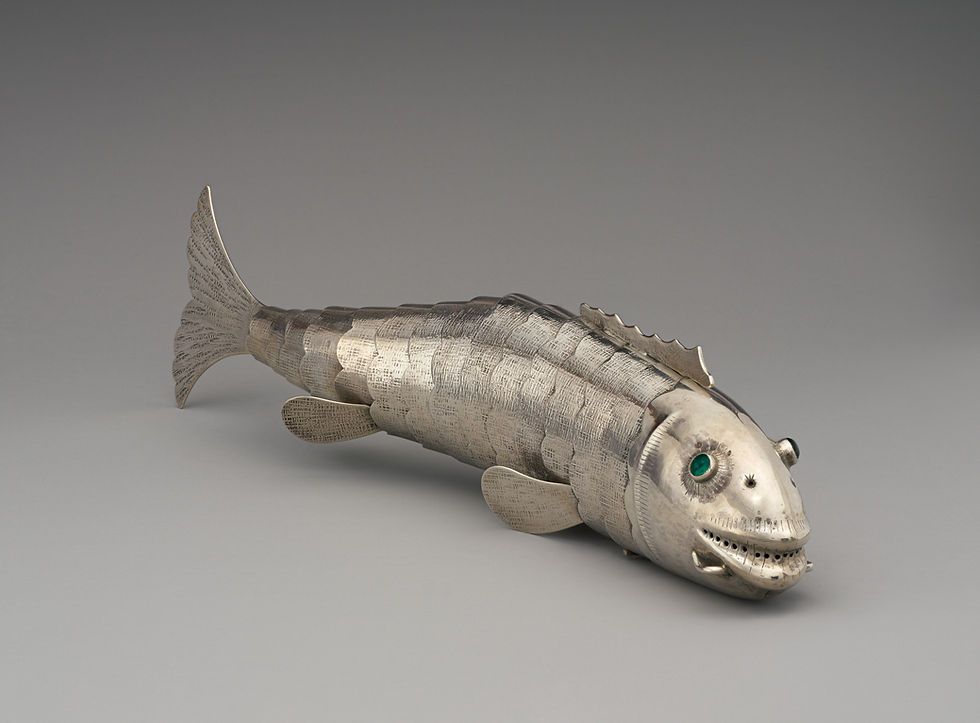
Fish-form spice container (Besamim), 1813. Angled view of the same fish; distinct from the Jewish Museum tower. Purchase, Manda and Albert Kalimian Gift, in honor of Sabrina and Daniel Kalimian, 2025. The Metropolitan Museum of Art. Public Domain, CC0. Collection · CC0 · Image policy
The Jewish Museum in New York holds a silver tower dated to around 1550, with repairs and additions assigned to 1650–51. Its catalogue tentatively places manufacture in Frankfurt am Main. Four architectural storeys contain openings shaped as windows, while a pinnacle and small turrets finish the top. The museum relates its form to architectural metalwork of the period and proposes a connection with the tower shapes of censers. That remains a historical interpretation, rather than proof of a single origin for all spice towers.
An opening with two purposes
On this object, an opening has two jobs at once. It contributes to the miniature architecture and interrupts the metal enclosure. The same void can be read as a window or as part of the vessel's relationship with air. That dual reading is the central design attraction: construction and representation meet in a very small feature. A tower form also gives the eye several stages to follow, from base to chamber to pinnacle, turning a handheld ritual object into an architectural sequence.
A Viennese spice container of 1813 in the Metropolitan Museum of Art takes the shape of a fish. Made from silver and foil-backed glass, it is thirty-four centimetres long. The head is hinged, and opening it reveals Hebrew letters designating the Ten Commandments. The Met notes that fish-shaped spice containers occur in the Jewish communities of Austria, Poland, Russia and Germany. The example is therefore part of a documented regional vocabulary, rather than a licence to assign a universal symbolism to every fish-shaped vessel.
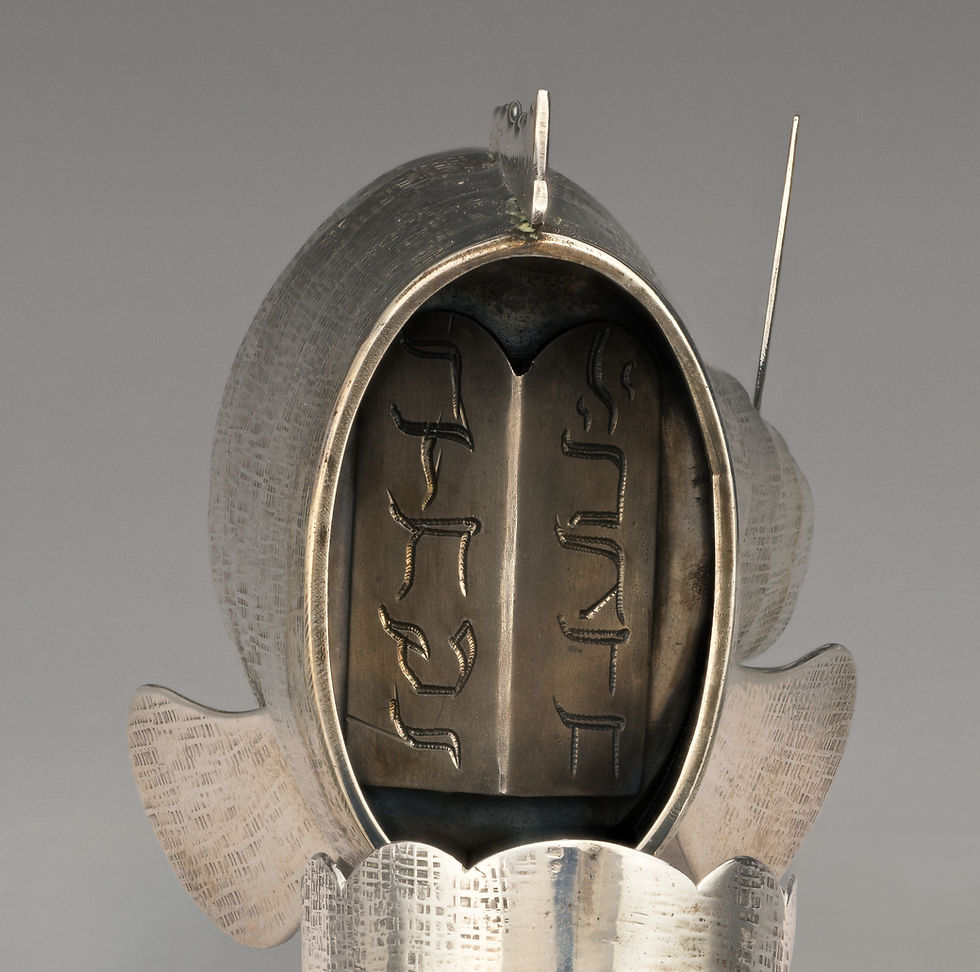
Fish-form spice container (Besamim), 1813. Open head, showing Hebrew letters designating the Ten Commandments. Purchase, Manda and Albert Kalimian Gift, in honor of Sabrina and Daniel Kalimian, 2025. The Metropolitan Museum of Art. Public Domain, CC0. Collection · CC0 · Image policy
Here the point of access becomes an anatomical joint. A seam between head and body supplies a place for the hinge, so an action required by the container is incorporated into the represented creature. The change from a tower to a fish also changes the object's dominant axis, from upright to horizontal. Those differences invite attention to how an object is held and approached, without assuming that every household followed an identical choreography. Form can shape an encounter even when the precise history of handling has not survived.
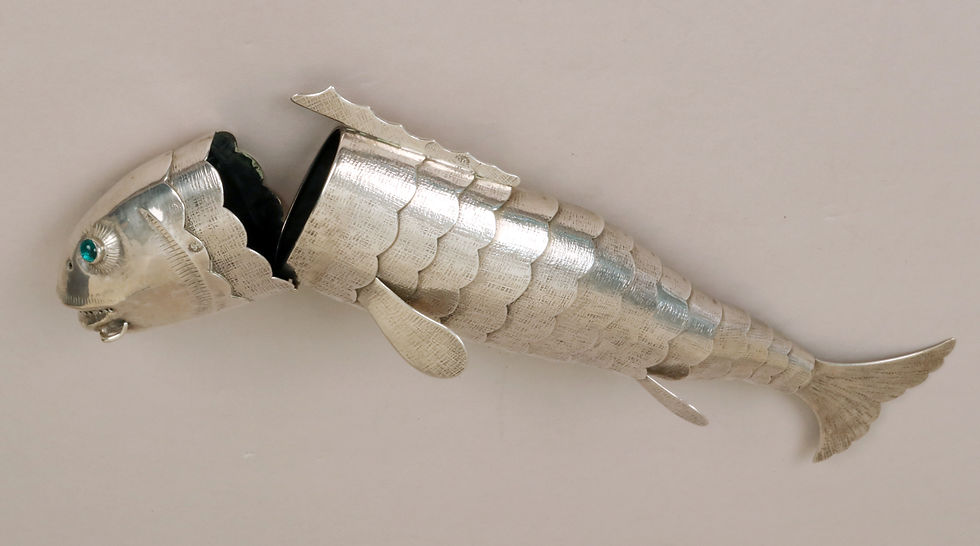
Fish-form spice container (Besamim), 1813. Same fish with head opened. Purchase, Manda and Albert Kalimian Gift, in honor of Sabrina and Daniel Kalimian, 2025. The Metropolitan Museum of Art. Public Domain, CC0. Collection · CC0 · Image policy
A form shaped around the hand
The North Carolina Museum of Art provides a later comparison in Iris Tutnauer's spice container, designed in 1998 and fabricated in 2014. Thin silver leaves form a pod inspired by cupped hands. The museum describes movable elements that allow spices to be placed inside and explains the relationship between the warmth of the hands and the release of fragrance. Its record also states that this particular object has not been used in a Havdalah ceremony. Designed ritual function and documented use are different kinds of evidence.
The comparison is revealing because the newer object makes the hand the basis of its outline, while the historical examples draw on a building and an animal. All can be considered through enclosure, access and the movement of scent. Their visual languages differ without making one more authentically functional than another. Elaborate representation need not be an obstacle to use, and a restrained surface does not by itself prove a closer relationship to ritual. Those judgements would overlook how meaning and operation coexist.

Fish-form spice container (Besamim), 1813. Detail of the same fish; historical comparison with Tutnauer’s silver pod. Purchase, Manda and Albert Kalimian Gift, in honor of Sabrina and Daniel Kalimian, 2025. The Metropolitan Museum of Art. Public Domain, CC0. Collection · CC0 · Image policy
A museum photograph cannot communicate the fragrance these vessels were intended to offer. It can, however, direct attention towards the features that make scent part of an object: the chamber, the aperture, the opening head, the space between silver leaves. Read alongside their cultural context, those features show design working across several senses. The spice container holds something temporary within a durable form, giving an aromatic moment an object through which it can be shared.


Comments