A Pattern Library in Thread: How Samplers Organised Learning
Rows, mirrored motifs and embroidered alphabets show how a piece of cloth could hold technical knowledge while becoming a composition in its own right.
An embroidery sampler can look like a crowded page: alphabets at the top, borders around the edge, motifs competing for the remaining ground. Yet its apparent abundance often follows a precise logic. A repeated letter tests consistency. Half a flower preserves enough information to recover the whole. A border gives a small design somewhere to continue. Read this way, the sampler is a material system for keeping and demonstrating knowledge, with the arrangement of the cloth as important as the individual stitches.

Lydia Pearson, Sampler, 1802. Friends of the American Wing Fund, by exchange, 2002. The Metropolitan Museum of Art. Public Domain, CC0. Collection · CC0 · Image policy
Ten real museum photographs show ten historical samplers, extending the article's comparison of alphabets, half-motifs, borders and pictorial arrangements. The selection includes archival black-and-white photographs, identified in the captions.
The Victoria and Albert Museum traces the sampler's early role as a reference piece for stitches, patterns and effects. Its history includes accomplished adult makers as well as children. In seventeenth-century England, it describes a growing educational use and two recognisable arrangements: scattered motifs on spot samplers, and ordered rows on band samplers. Those categories are useful because they identify alternative ways to organise information. One keeps examples distinct; the other encourages comparison across a continuous sequence of horizontal divisions.

Embroidered sampler, ca. 1761. Later band-sampler comparison. Gift of Mrs. Henry Stockwell Gibson, 1936. The Metropolitan Museum of Art. Public Domain, CC0. Collection · CC0 · Image policy

Mary Austin, Sampler, 1784. Later alphabet-and-picture comparison. Gift of Mrs. Screven Lorillard, 1953. The Metropolitan Museum of Art. Public Domain, CC0. Collection · CC0 · Image policy
A band provides a particularly economical teaching format. Its boundaries make a repeated unit easy to follow, while the next band can introduce a different scale or rhythm without requiring a new piece of cloth. The V&A notes that alphabets also had a practical destination: marking household and personal linen. Letterforms were therefore transferable skills, rather than purely literary decoration. In a design reading, their repeated placement joins two kinds of order, the sequence of the alphabet and the measured sequence of the stitched line.

Mary Elizabeth Morse, Sampler, 1840. Later alphabet-row comparison. Friends of the American Wing Fund, 2015. The Metropolitan Museum of Art. Public Domain, CC0. Collection · CC0 · Image policy
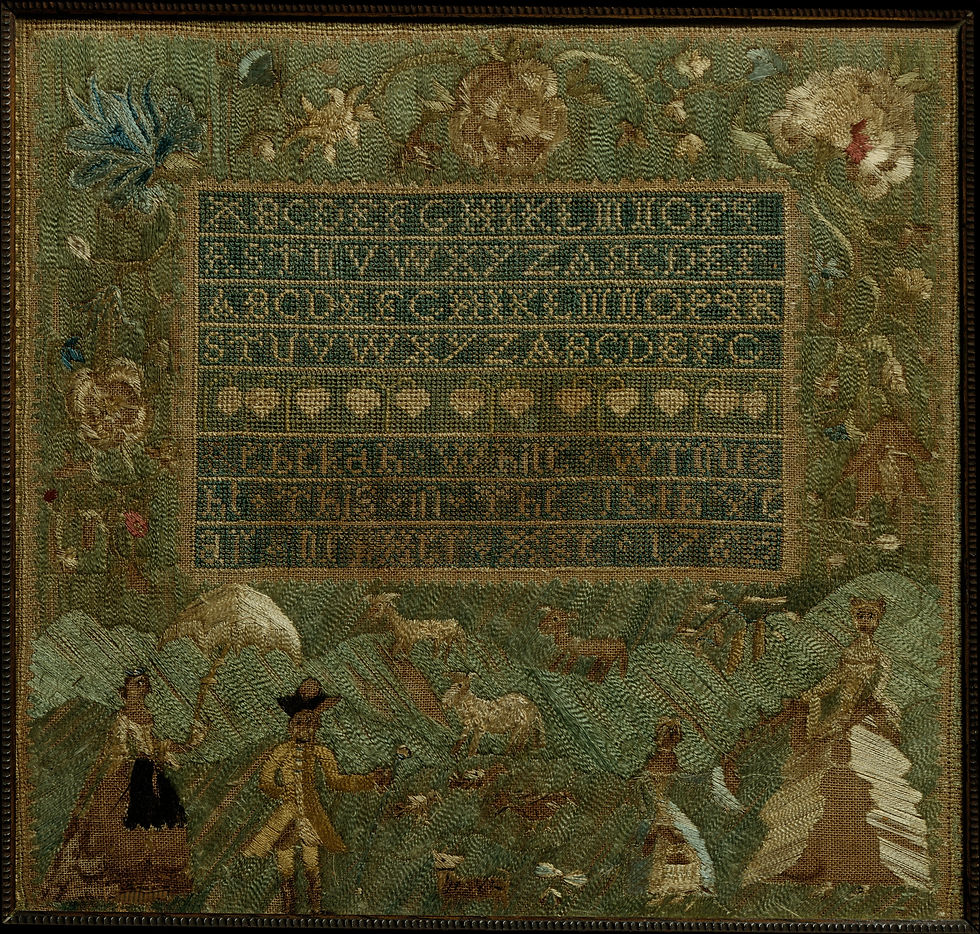
Rebekah White, Sampler, 1766. Alphabet-and-border comparison. Gift of Barbara Schiff Sinauer, 1984. The Metropolitan Museum of Art. Public Domain, CC0. Collection · CC0 · Image policy
A pattern that can be recovered
A sampler signed A. H., dated 1810 and held by the Metropolitan Museum of Art, makes the economy of pattern storage unusually clear. The museum identifies its half-motifs as characteristic of Quaker schooling. A maker could reproduce a complete design later by mirroring the portion already recorded. The exact school, and whether the sampler originated in England or America, remain uncertain. Its dark green silk embroidery on coarse linen nevertheless preserves a concrete teaching method: learn a sufficient part, then use symmetry to reconstruct the rest.

A. H., Embroidered Sampler, 1810. School and English/American origin uncertain; original monochrome photograph. Rogers Fund, 1913. The Metropolitan Museum of Art. Public Domain, CC0. Collection · CC0 · Image policy
That is a sophisticated distinction between a finished picture and a usable pattern. A complete flower may be pleasing to display, but a half-flower can be enough to transmit an instruction. Empty ground beside a motif need not represent something missing. It can belong to an efficient arrangement of examples. The sampler invites a reader who understands how to complete what is present. Its design resides partly in those repeatable relationships, rather than in the quantity of cloth covered with thread.
Other pieces organise instruction into a more pictorial whole. Rebecca Barnes's American sampler of 1818, in the Smithsonian's Cooper Hewitt collection, sets a named central wreath among symmetrically arranged flowers and birds. An alphabet sits above, and strawberry-vine and floral borders surround the field. The record identifies cross stitch in silk on a linen foundation. Here a central focus, an outer boundary and paired motifs make the separate elements cohere. The result can be read both as an assembly of skills and as a carefully balanced surface.

Rebecca Gallyon, Embroidered sampler, 1792. Monochrome comparison, distinct from Rebecca Barnes’s Cooper Hewitt sampler. Gift of Barbara Schiff Sinauer, 1984. The Metropolitan Museum of Art. Public Domain, CC0. Collection · CC0 · Image policy

Mary Parker, Sampler, 1805. Monochrome comparison, distinct from Rebecca Barnes’s Cooper Hewitt sampler. Gift of Mrs. Sandford D. Neely, 1954. The Metropolitan Museum of Art. Public Domain, CC0. Collection · CC0 · Image policy
The evidence of a name
The name changes that surface, too. It associates technical work with a particular maker, even when much about her training is unknown. A museum essay on Lydia Pearson's sampler of 1802 offers another documented instance: Pearson was eleven when she made it, combining alphabets, flowers and verse. The same essay discusses Rebecca Marsh's 1802 sampler, which names the Westtown Quaker School. Such inscriptions can preserve evidence about education and authorship. They should not, on their own, be made to reveal every maker's private feelings or degree of independence.

Rebecca Marsh, Sampler made at the Westtown Quaker School, 1802. Gift of Virginia F. Thors, 2005. The Metropolitan Museum of Art. Public Domain, CC0. Collection · CC0 · Image policy

Elizabeth L[ydia] Smith, Sampler, 1825. Related family-record sampler. Purchase, Joel B. Leff Gift, 2000. The Metropolitan Museum of Art. Public Domain, CC0. Collection · CC0 · Image policy
These distinctions matter when discussing girls' historical needlework. An educational exercise could support real expertise while also belonging to prescribed expectations for female work. The objects preserve what was stitched more reliably than they preserve the conversations around its making. Looking closely means attending to that evidence: the chosen ground, the repeat, the use of mirrored forms, the relation of text to border. A sampler can communicate disciplined decision-making without requiring an invented story about either obedience or rebellion.
Its most compelling design lesson is the connection between storage and composition. The recorded pattern is useful because it can be returned to; the composition makes that return legible. Ordered bands, isolated motifs and framed fields offer different routes through accumulated knowledge. In each, the cloth becomes a working arrangement of examples. The sampler's beauty emerges from those relationships, making visible the act of learning how one small unit can become a line, a border or an entire design.


Comments