The Flap That Finishes the Book
On surviving Islamic bookbindings, a pointed extension reveals the book as a moving enclosure, designed around the exposed edge of its pages.
Laid open, a fifteenth-century bookbinding in the Cleveland Museum of Art extends beyond the familiar pair of rectangular covers. At one end, a narrow panel leads to a tapered flap. Around a closed manuscript, the narrow section turns across the exposed page edge and the flap continues beneath the front cover. Its outline accommodates the book's thickness.
Cleveland dates this Qur'an binding to 1460–1500 and identifies it with Ottoman Istanbul. Leather covers paper pasteboards; the catalogue records tooling and blue paint outside, with openwork leather over coloured papers inside. The museum explains that the flap protects the page edge. This enclosure had to open for reading, then recover its shape around the text.
An enclosure with a moving edge
The decoration observes that arrangement. The outer covers carry Qur'anic inscriptions, interlace and central medallions; the pointed extension receives its own bounded design. Large fields, a narrow strip and a tapering termination make the folds intelligible. Ornament connects differently sized surfaces without disguising their separate proportions.
A much smaller binding at the Metropolitan Museum of Art makes that protective scheme apparent through an absence. Made in Egypt or Syria in the first half of the fourteenth century, it survives without the flap that once protected its manuscript's front edge. Its stamped and gilded leather still carries an intricate, blind-tooled geometric design on both covers. The lost extension leaves a record that is visually complete enough to reward looking, yet structurally incomplete.
At the centre of that design, overlapping hexagons and eight-pointed stars generate an interlacing pattern. The Met places it within a Mamluk decorative vocabulary also used in woodwork and stone mosaics. That comparison is useful at the level of surface organisation. Calling the binding a small piece of architecture is an interpretation of its enclosing form, rather than evidence that its maker copied a building. Its surviving faces and missing closure simply make the act of housing a manuscript unusually clear.

One cover of a Mamluk bookbinding, Egypt or Syria, first half of the 14th century. Its interlacing geometry survives, but the binding has lost its protective flap.
What a fragment preserves
Another Met object preserves the component the smaller binding has lost. Catalogued as Flap of Bookbinding, it is a fourteenth-century work attributed to Egypt, made from leather, silk and gold. Standing thirty-six centimetres high, it is substantial even in isolation. The museum describes the envelope flap's route from the back cover, around the pages and under the front. A fragment can therefore retain evidence of an action after the book that gave that action purpose has disappeared.
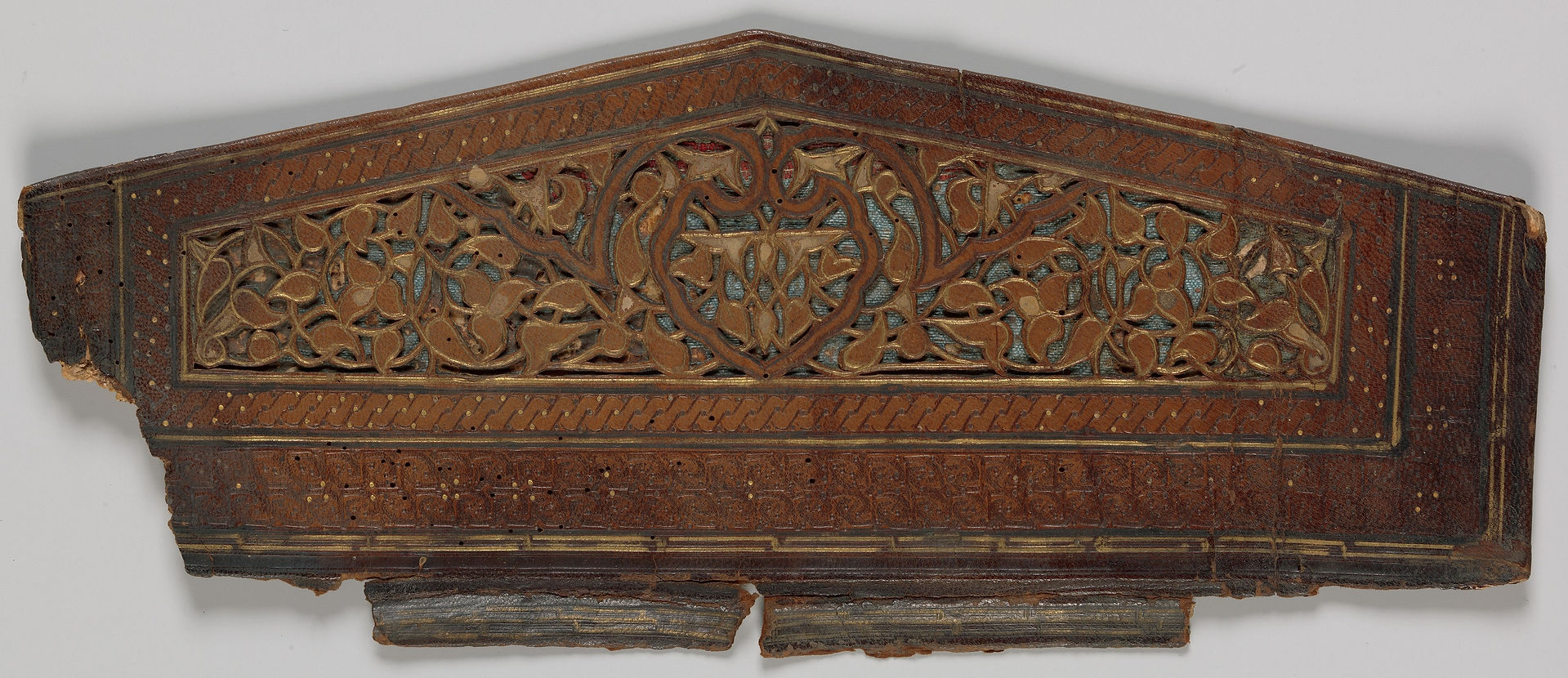
Flap of Bookbinding, attributed to Egypt, 14th century. Cut and tooled leather, silk and gold preserve the pointed outline of an envelope flap.
That route changes how the piece should be pictured. An image of a detached flap invites attention to a silhouette and a decorated surface. Its original position asks the viewer to imagine turning, overlapping and concealment. Part of the binding's design becomes less visible when the book is closed. This is an object organised around a reader's changing access, with different surfaces available before, during and after use.

The textile-lined side of the same 14th-century flap, with wear exposing its layered construction.
A binding in the Aga Khan Museum offers a later comparison with its covers, flap and inner linings still considered together. The museum places it in Turkey, possibly in the late sixteenth century, and identifies leather, pasteboard and gold. Its outer decoration centres on a medallion, pendants and cornerpieces, a composition the museum traces through a long Ottoman binding tradition. Here the repeated motifs make the rectangular covers and smaller flap recognisably parts of one enclosure.
Connected surfaces
The museum's photographs show this binding spread open and with its flap folded across the cover. These are two readings of the same object. Flat, it resembles a sequence of connected panels; folded, it becomes an overlapping package. Its worn joints also interrupt the impression of an untouched decorative skin. They draw attention back to places that had to bend, even when the surrounding surfaces were richly worked.
None of these surviving covers should be treated as a complete diagram of all Islamic bookbinding. Their dates, materials and states of preservation differ. Together, however, they allow one modest component to be followed closely. The envelope flap extends care around a vulnerable edge, then gives way when the text is needed. To understand the binding, look beyond its central medallion and follow its perimeter. The book's outer boundary is where much of its design happens.
Sources
Image credits and licensing
Image: The Metropolitan Museum of Art, New York. Rogers Fund, 1933, 33.14. CC0. Source: https://www.metmuseum.org/art/collection/search/448906 License: https://creativecommons.org/publicdomain/zero/1.0/ Original photograph reproduced without alteration.
Image: The Metropolitan Museum of Art, New York. Gift of Dr. Maurice S. Dimand, in honor of Dr. Richard Ettinghausen, 1970, 1970.62. CC0. Source: https://www.metmuseum.org/art/collection/search/452085 License: https://creativecommons.org/publicdomain/zero/1.0/ Original photograph reproduced without alteration.
Image: The Metropolitan Museum of Art, New York. Gift of Dr. Maurice S. Dimand, in honor of Dr. Richard Ettinghausen, 1970, 1970.62. CC0. Source: https://www.metmuseum.org/art/collection/search/452085 License: https://creativecommons.org/publicdomain/zero/1.0/ Original photograph reproduced without alteration.


Comments