Shoe Buckles and the Part That Could Change
An eighteenth-century shoe buckle was a separate object with its own structure and ornament. Its removability made fastening a form of variation.
In a photograph of a shoe buckle, the large empty centre can be surprising. The decoration occupies the perimeter, while a smaller set of bars and prongs crosses the opening. One part asks to be seen; another has to hold. Their relationship explains why an eighteenth-century buckle can look complete as an object even when the shoe is absent. It is a distinct piece of equipment, shaped to join another object and capable of carrying an elaborate visual identity of its own.
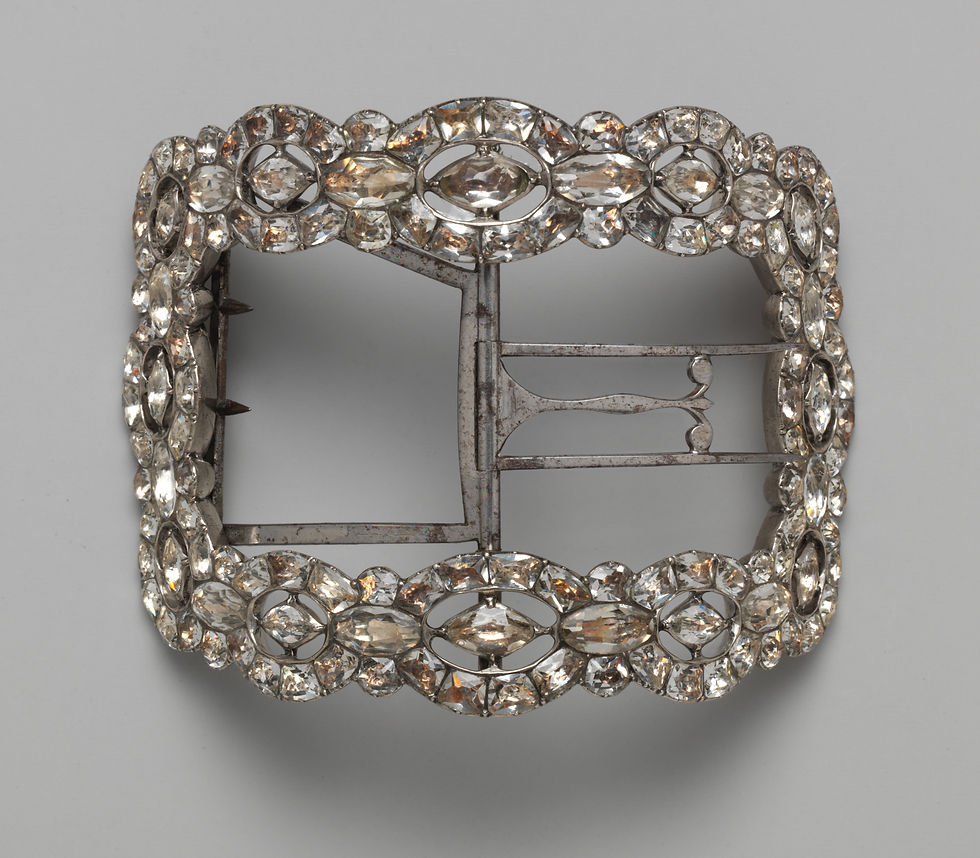
Shoe buckles, British, late 18th century. Single buckle, front. The Metropolitan Museum of Art. Purchase George White Thorne Bequest, 1883. Public Domain (CC0). Collection · CC0 · Image policy
Ten real museum photographs show historical shoe buckles from the front, reverse and side, allowing decorative frames to be compared with the fittings behind them.
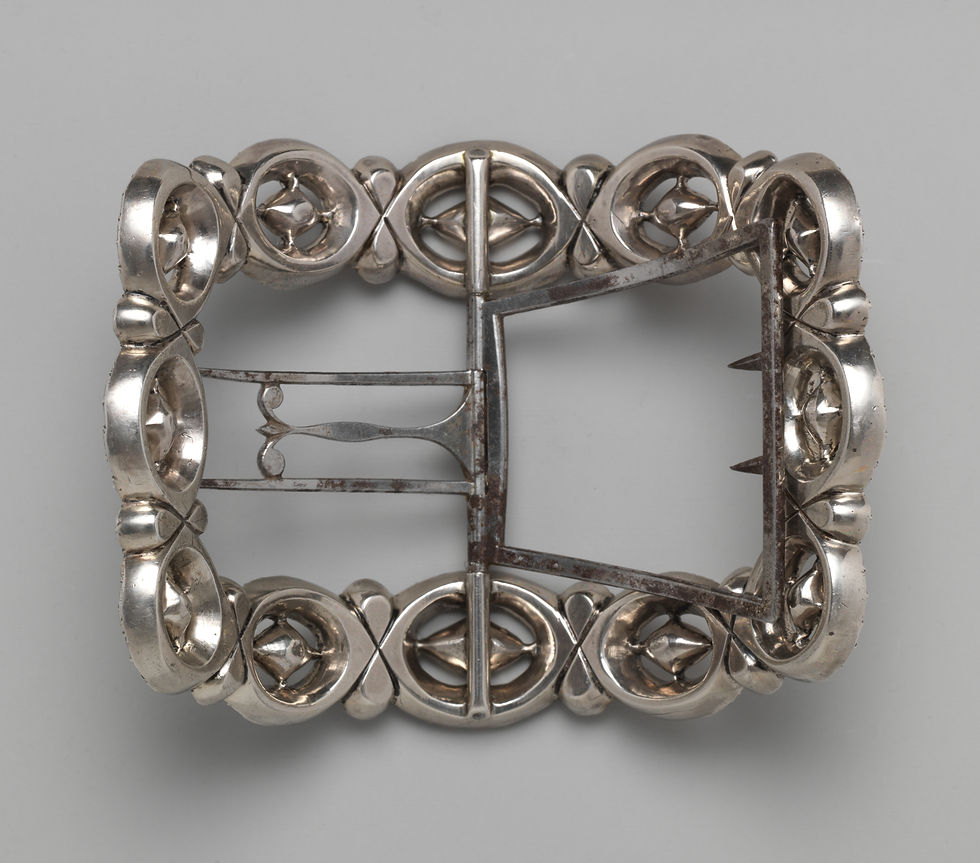
Shoe buckles, British, late 18th century. Reverse of the same buckle. The Metropolitan Museum of Art. Purchase George White Thorne Bequest, 1883. Public Domain (CC0). Collection · CC0 · Image policy
Ten real museum photographs show historical shoe buckles from the front, reverse and side, allowing decorative frames to be compared with the fittings behind them.
Colonial Williamsburg's account of historic clothing explains that shoe buckles were made to be removed and transferred between pairs of shoes. It identifies their arched shape, which fits over the instep, and the fork-like fittings that secure the shoe straps. These features make the category more specific than a decorated rectangle. Curvature relates it to the foot; the fastening relates it to the leather or textile parts of the shoe. A successful design has to reconcile those relationships with the ornament on its outward-facing frame.
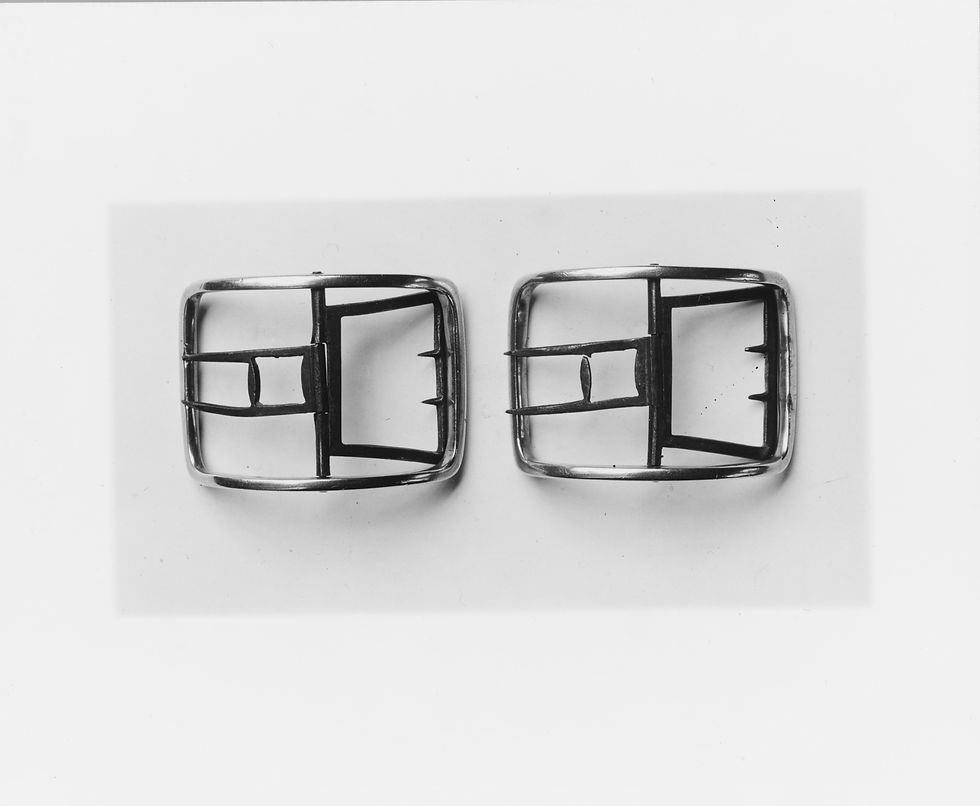
Shoe Buckle, American, ca. 1800. Comparative curved silver frames. The Metropolitan Museum of Art. Bequest of Alphonso T. Clearwater, 1933. Public Domain (CC0). Collection · CC0 · Image policy

Shoe buckles, British, 1784–85. Comparative silver buckle and fastening. The Metropolitan Museum of Art. Gift of Susan Dwight Bliss, 1942. Public Domain (CC0). Collection · CC0 · Image policy
A British pair in the Metropolitan Museum of Art, dated to the late eighteenth century, is catalogued in metal and paste. Its frame gathers large oval and smaller rounded stones into a clustered border. The centre remains open, allowing the functional assembly to sit within the surrounding display. Looking closely, the decorative edge has its own rhythm, with changes of stone size drawing attention around the rectangle. The structure reserves a generous central void while concentrating brightness along the boundary most visible when the buckle is in place.
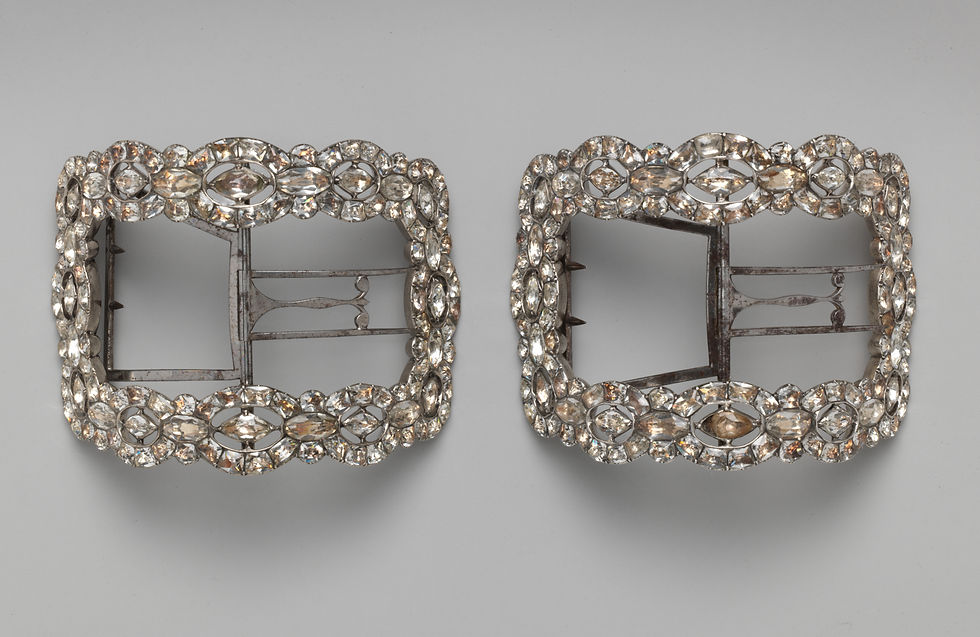
Shoe buckles, British, late 18th century. Pair, front. The Metropolitan Museum of Art. Purchase George White Thorne Bequest, 1883. Public Domain (CC0). Collection · CC0 · Image policy
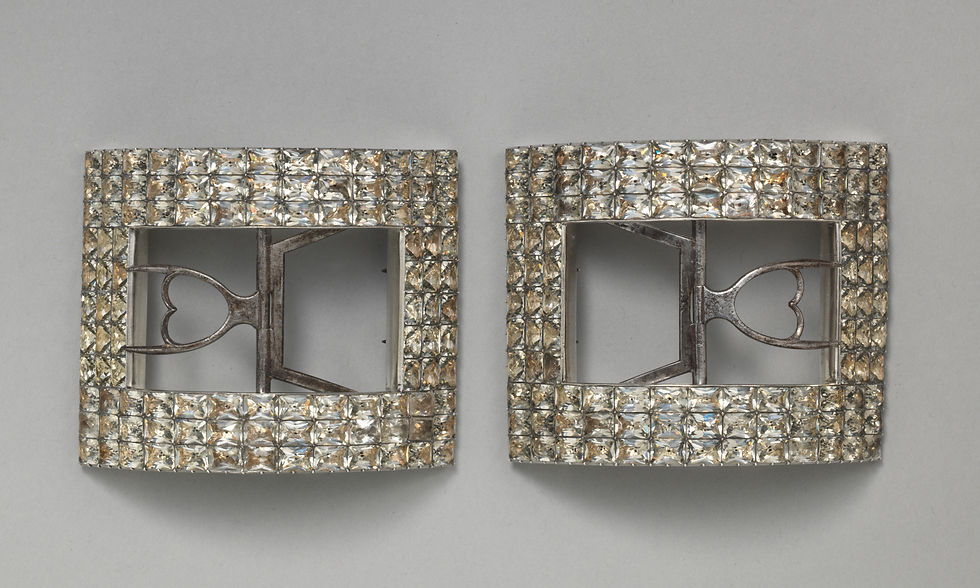
Shoe buckles, British, late 18th century. Separate paste-set pair for comparison. The Metropolitan Museum of Art. Purchase George White Thorne Bequest, 1883. Public Domain (CC0). Collection · CC0 · Image policy
One frame, several effects
Another late eighteenth-century British example in the Met combines paste, silver and steel. Its border is more regular, with repeated stones following a rounded rectangle. A late eighteenth-century European steel pair offers a further variation: dark openwork along the rim and exposed fittings make metal and interval carry the pattern. These are three ways of dividing a similar area. Closely packed stones turn the frame into a band of light; a more open rim lets the background participate; a consistent rectangular outline keeps the mechanisms visually contained.
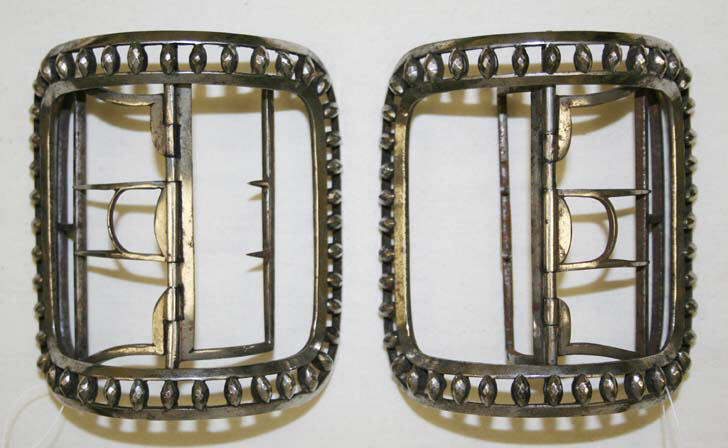
Shoe buckles, European, late 18th century. The Metropolitan Museum of Art. Gift of Mr. Lee Simonson, 1944. Public Domain (CC0). Collection · CC0 · Image policy
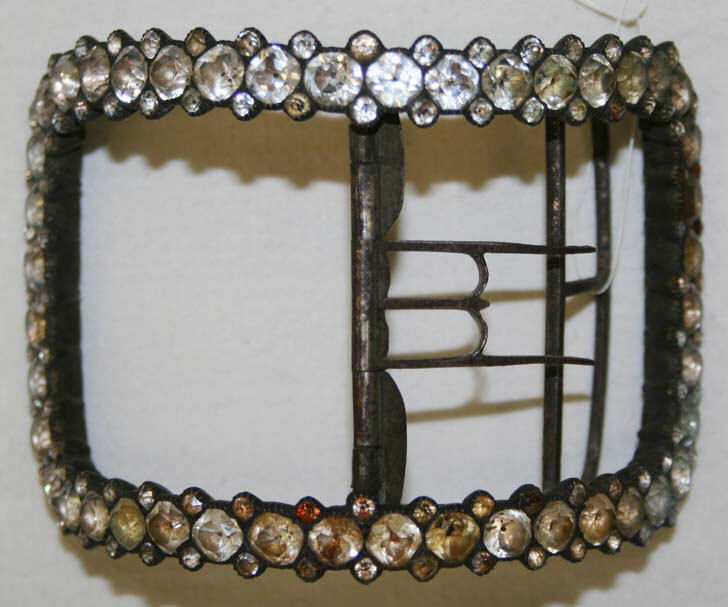
Shoe buckles, British, late 18th century. The Metropolitan Museum of Art. Purchase George White Thorne Bequest, 1883. Public Domain (CC0). Collection · CC0 · Image policy
Interchangeability also complicates the evidence of surviving pairs. Colonial Williamsburg holds women's shoes made in London by Thomas Ridout and James Davis in the 1740s. Their brocaded silk uppers have high tongues and straps for removable buckles. The shoes arrived with oval buckles that the museum dates to about 1790 and identifies as later additions. That mismatch makes an important point: a shoe and its present buckle need not record one original decision. Their association can be part of an object's subsequent life, and should be described accordingly.
A pair of shoe buckles with a case at the Rijksmuseum, dated about 1775–1800, shows how the detachable component could be stored as a valued object. Silver settings hold rhinestones, and the catalogue describes a cardboard case lined with velvet and silk. The museum interprets the separate pouch as suggesting use for special occasions. The case also gives a design clue. It provides a home for the buckles when they are off the foot, acknowledging their independent dimensions, projecting parts and surfaces worth protecting.
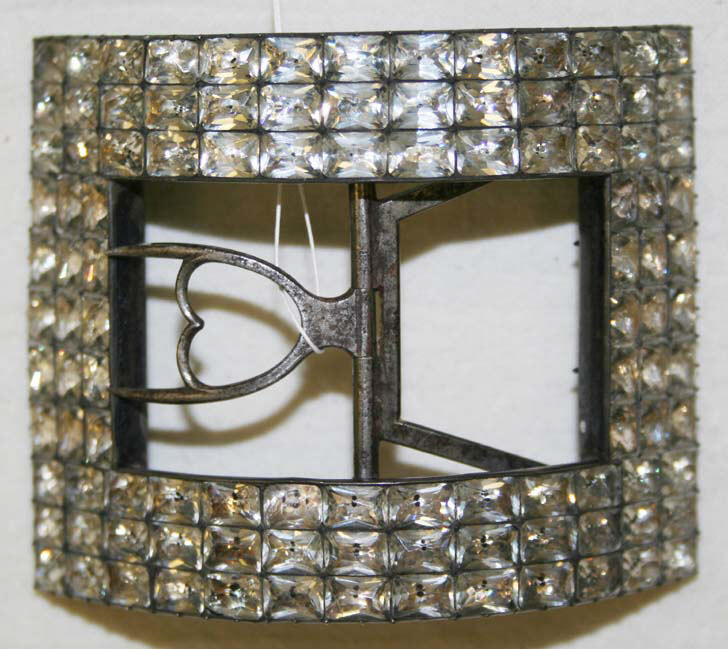
Shoe buckles, British, late 18th century. Detail of the separate paste-set pair; comparison, distinct from the Rijksmuseum’s cased buckles. The Metropolitan Museum of Art. Purchase George White Thorne Bequest, 1883. Public Domain (CC0). Collection · CC0 · Image policy
The separable component
The distinction between frame and fastening becomes especially clear when a mechanism has changed. A pair dated about 1770–1780 at Monmouth History is attributed to New York or New Jersey. Its catalogue identifies silver rims and steel pins, and cautiously describes one chape-and-tongue assembly as apparently original and the other as an apparent replacement. Those qualifications should remain intact. They reveal how careful comparison can locate differences within what initially looks like a matched pair, and how the useful underside of an accessory may carry evidence that its ornamental face conceals.

Shoe buckles, British, late 18th century. Pair, reverse; comparison, distinct from Monmouth History’s pair. The Metropolitan Museum of Art. Purchase George White Thorne Bequest, 1883. Public Domain (CC0). Collection · CC0 · Image policy
For a contemporary eye accustomed to shoes sold as finished units, these objects offer a different way to consider completeness. The shoe supplied one set of materials, colours and contours; the buckle supplied another, joined by a working interface. Changing that component could change the appearance without rebuilding the whole shoe. The historical evidence does not require a modern sustainability slogan to make the arrangement interesting. Its ingenuity lies in allowing fit, attachment, surface and storage to belong to related but separable parts, each with an identity that could survive a new combination.


Comments