Chatelaines: A Small Toolkit at the Waist
Chatelaines arranged writing, grooming and other small implements around a single attachment point. Their chains made organisation part of the ornament.
A chatelaine begins with a practical decision: put several things within reach of the same hand. In the Metropolitan Museum of Art's nineteenth-century example, a decorated clip branches into chains carrying a notebook, pencil, sealing-wax holder and small purses. Each item has its own outline and place in the hanging arrangement. Seen against a plain background, the assembly resembles a diagram of relationships: one attachment at the top, several routes below, and a useful object at the end of each route.

Chatelaine, probably French, fourth quarter 19th century. The Metropolitan Museum of Art. Brooklyn Museum Costume Collection at The Metropolitan Museum of Art, Gift of the Brooklyn Museum, 2009; Gift of Miss H. O. Kleber, 1961. Public Domain (CC0). Collection · CC0 · Image policy
Ten original museum photographs of four chatelaines, including separate views of their cases, tools, attachments and ornament.
The Met identifies this example as probably French, from the fourth quarter of the nineteenth century, and lists metal, enamel and paper among its materials. The qualification matters; its elaborate surface is not evidence of a securely documented workshop. The museum explains that a hook behind the central clip attached it to a waistband or belt. That concealed hook is the point where the whole arrangement becomes wearable. The broad decorative front provides a visual centre while the individual chains permit the objects below to separate.
Another Met object, a South Staffordshire nécessaire and châtelaine dated about 1765–70, offers a different answer to the same problem. Its enameled-copper case held scissors, a penknife, a pencil holder, two ivory writing tablets and a combined tweezer and nail-file implement. Two small, egg-shaped scent containers flank the central case. The museum notes that the pink container is probably a later addition. It also records equipage as the eighteenth-century name for this kind of ornamental waist clasp, a useful reminder that today's familiar label spans objects with their own historical terminology.
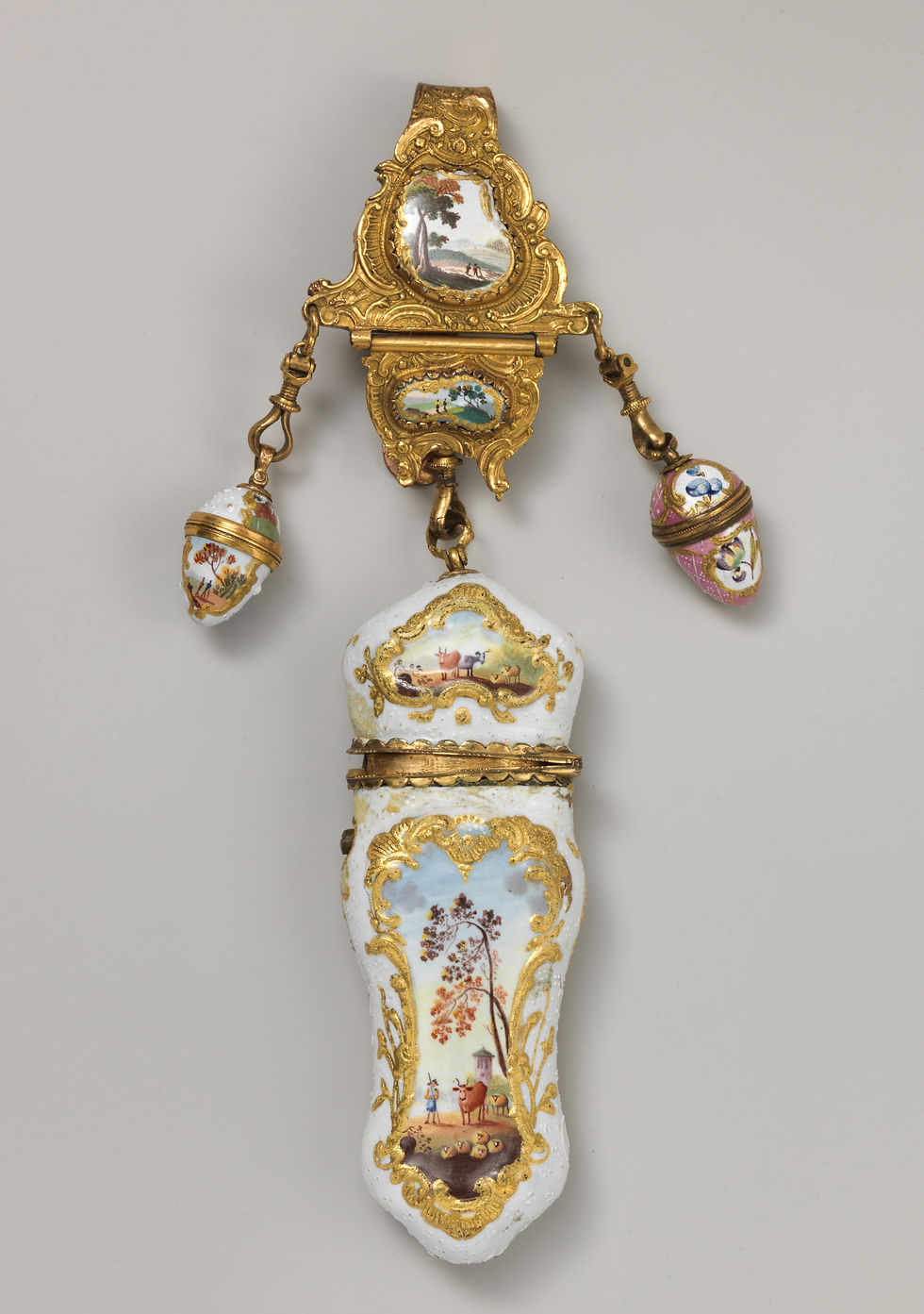
Nécessaire and châtelaine, British, South Staffordshire, ca. 1765–70. Closed front; pink scent container probably added later. The Metropolitan Museum of Art. Bequest of Mary Clark Thompson, 1923. Public Domain (CC0). Collection · CC0 · Image policy
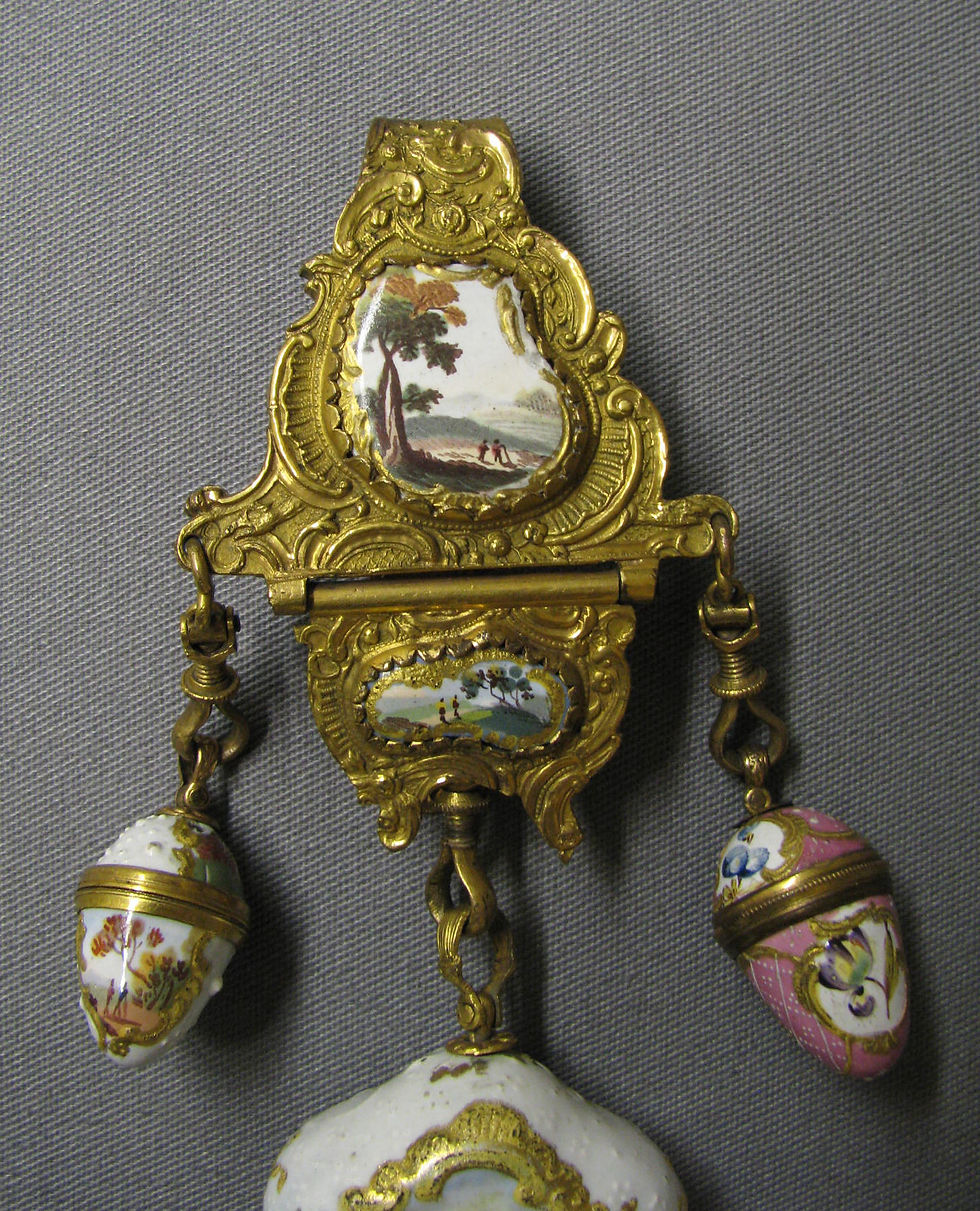
Nécessaire and châtelaine, British, South Staffordshire, ca. 1765–70. Clasp detail; pink scent container probably added later. The Metropolitan Museum of Art. Bequest of Mary Clark Thompson, 1923. Public Domain (CC0). Collection · CC0 · Image policy
Tools within tools
Here, much of the organisation happens inside the case. Viewed open, the narrow tools repeat the case's length; viewed shut, their different purposes disappear into one continuous decorated shell. The shape mediates between the hand-sized instruments and the larger composition worn on the body. Its taper also gives the eye a clear downward route from clasp to tip. The result is a nested arrangement: tools within a container, a container within a set of pendants, and the whole set attached to dress.
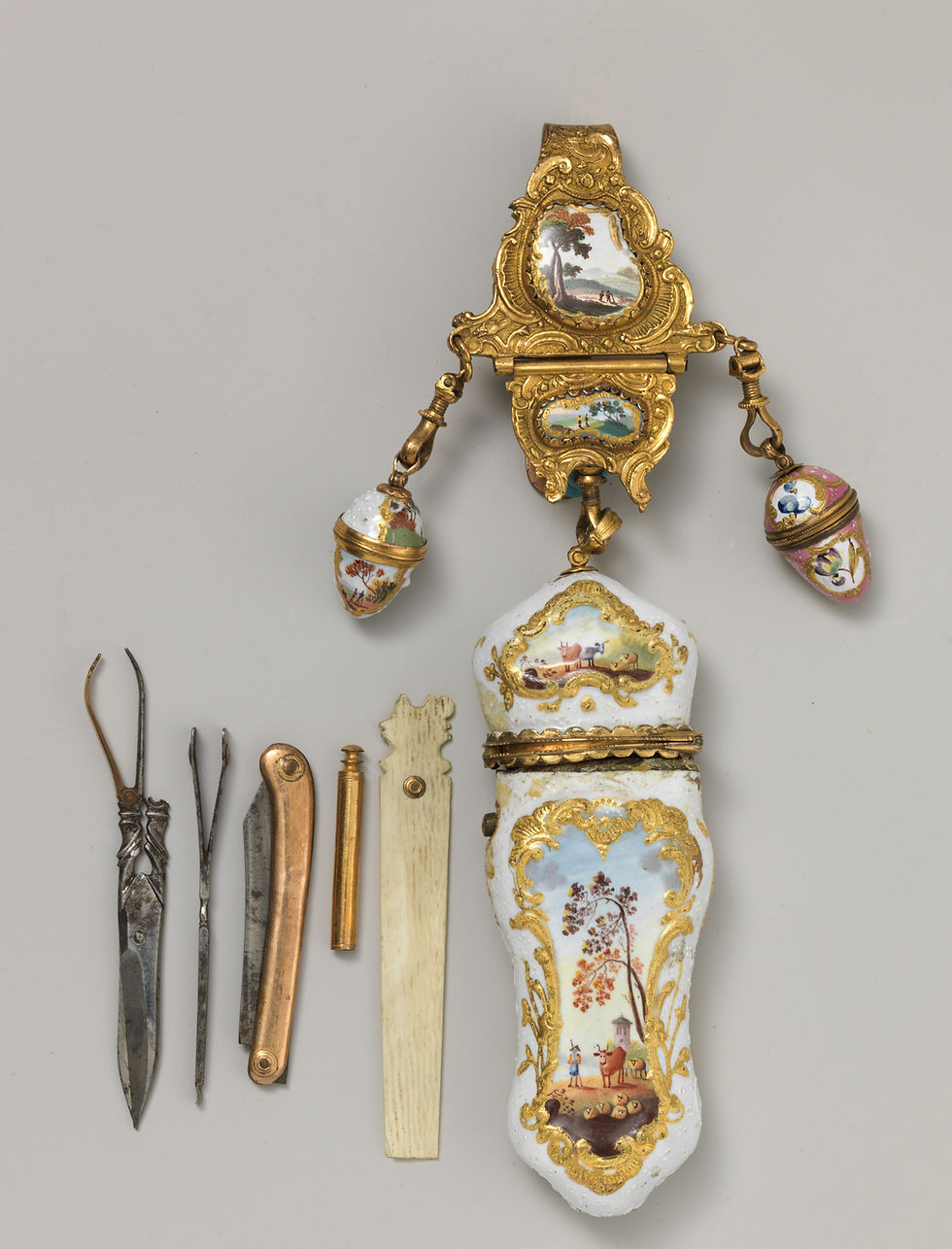
Nécessaire and châtelaine, British, South Staffordshire, ca. 1765–70. Open case and tools. The Metropolitan Museum of Art. Bequest of Mary Clark Thompson, 1923. Public Domain (CC0). Collection · CC0 · Image policy
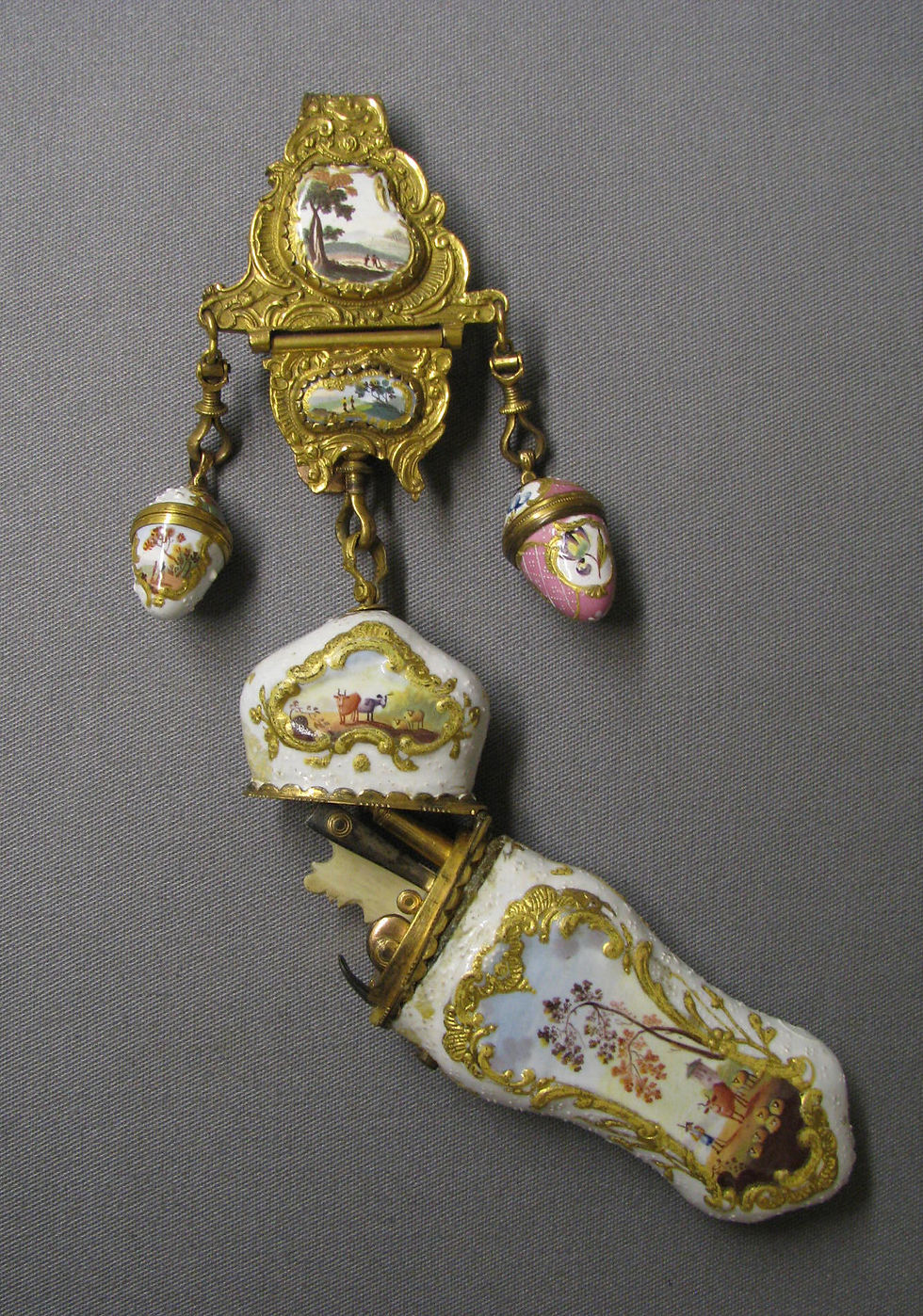
Nécessaire and châtelaine, British, South Staffordshire, ca. 1765–70. Open-lid view of the same nécessaire. The Metropolitan Museum of Art. Bequest of Mary Clark Thompson, 1923. Public Domain (CC0). Collection · CC0 · Image policy
The calendar chatelaine in the same collection is catalogued as French and probably late eighteenth century, in steel and enameled gold. Its metal chains and hanging loops are conspicuous, establishing a more open silhouette around a dense ornamental centre. Space between the chains becomes part of the design. Where the fitted case concentrates attention on its continuous surface, this object lets the outline dissolve into smaller moving components. Even when photographed at rest, the separate links make its capacity to articulate legible.

Chatelaine with calendar, French, probably late 18th century. Front. The Metropolitan Museum of Art. Gift of Joseph G. Reinis, 2011. Public Domain (CC0). Collection · CC0 · Image policy

Chatelaine with calendar, French, probably late 18th century. Reverse of the same calendar chatelaine. The Metropolitan Museum of Art. Gift of Joseph G. Reinis, 2011. Public Domain (CC0). Collection · CC0 · Image policy
Material changes the reading of these structures. The museum's eighteenth-century British chatelaine combines gold, enamel and diamonds; its central elongated case and smaller side pendants give the arrangement a strongly balanced front. Colour and stones draw attention toward discrete areas, while the hanging connections keep those areas related. In a collection photograph, the whole can be read at two distances: first as a compact ornament, then as a series of cases, borders and links. The tool system also provides the framework for an unusually concentrated display of decorative detail.
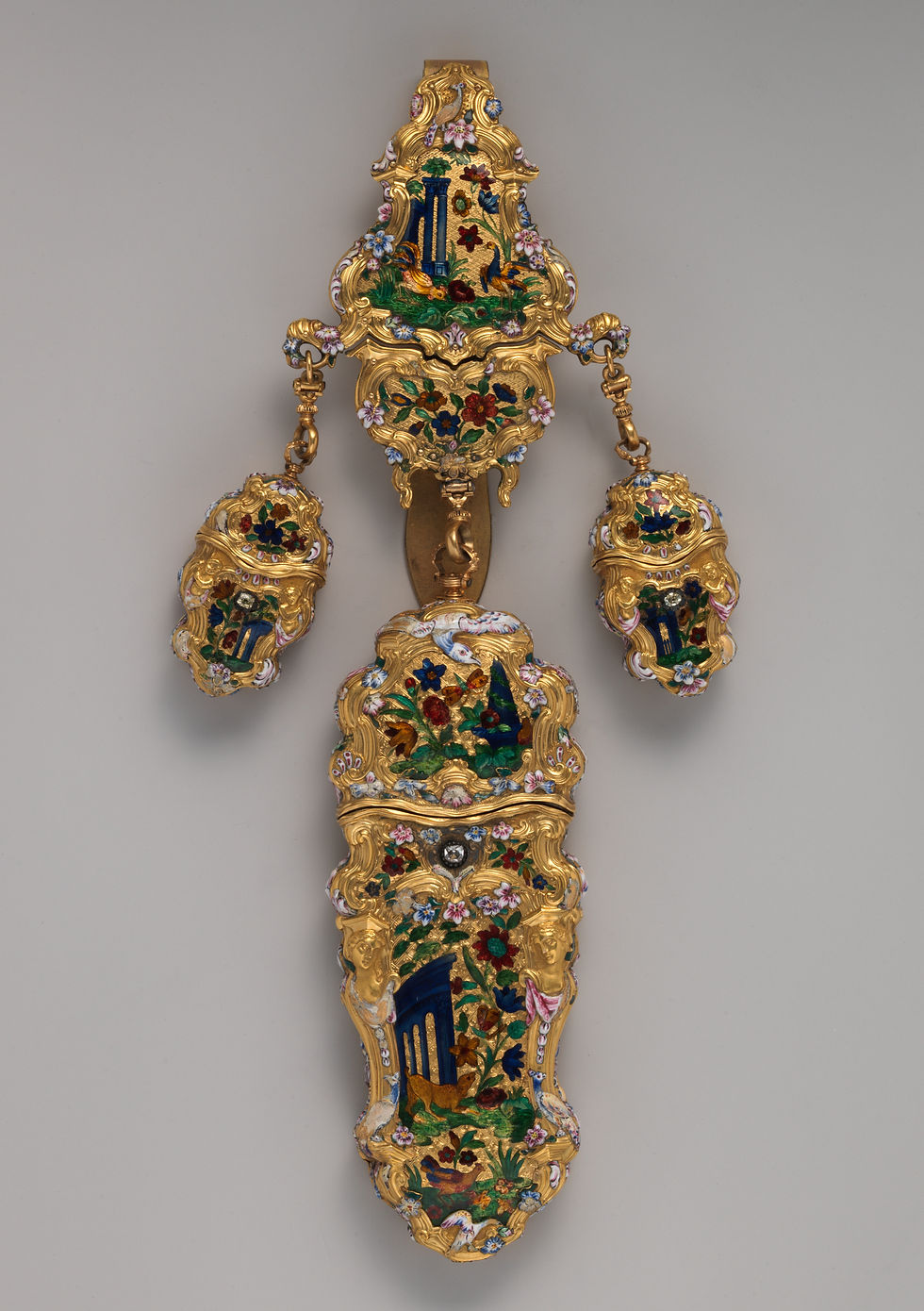
Chatelaine, British, 18th century. The Metropolitan Museum of Art. The Friedsam Collection, Bequest of Michael Friedsam, 1931. Public Domain (CC0). Collection · CC0 · Image policy

Chatelaine, British, 18th century. Detail of the same British chatelaine. The Metropolitan Museum of Art. The Friedsam Collection, Bequest of Michael Friedsam, 1931. Public Domain (CC0). Collection · CC0 · Image policy
The design of gathering
The design question is how much to gather together. A fitted container protects and visually unifies its contents, but an individual implement has to be reached through that enclosure. Separate hanging objects advertise their distinct forms and distribute the composition across a broader area. These are readings of the surviving arrangements rather than claims about any particular wearer's habits. They help explain why two objects with a shared waist attachment can produce such different silhouettes. Organisation becomes visible through spacing, relative length and the decision to expose or conceal each component.

Nécessaire and châtelaine, British, South Staffordshire, ca. 1765–70. Alternate decorated face of the same nécessaire; pink scent container probably added later. The Metropolitan Museum of Art. Bequest of Mary Clark Thompson, 1923. Public Domain (CC0). Collection · CC0 · Image policy
That is what makes a chatelaine interesting as a piece of design today. Its usefulness and its appearance depend on the same small decisions. The principal clasp gathers weight; a case establishes hierarchy; chains create intervals; a secondary pendant changes the balance. Looking closely also keeps the category from becoming a single romantic story about life without pockets. The objects preserve specific combinations of writing, grooming, scent and ornament, with additions and uncertain attributions still attached to their histories. Their most persuasive lesson lies in how carefully a handful of separate things can be composed into something worn.


Comments