Matthieu Blazy’s Second Couture Show for Chanel: A Dark Fairy Tale at the Grand Palais
Updated: Aug 28

Matthieu Blazy’s Second Couture Show for Chanel: A Dark Fairy Tale at the Grand Palais
For his second haute couture collection at Chanel, Matthieu Blazy invited the audience into a fairy tale—but not one built around passive princesses, perfect romance or predictable happy endings.
Presented at the Grand Palais in Paris on 7 July 2026, Chanel Haute Couture Fall/Winter 2026–2027 transformed the monumental venue into an enchanted landscape of climbing plants, enormous flowers, magic mirrors and an imposing beanstalk. The theatrical environment introduced a collection in which childhood stories, Chanel’s history and the realities of modern women became part of the same narrative. (AP News)
Yet beneath the fantasy, Blazy’s proposition remained remarkably grounded. His couture was not conceived merely to be observed from a distance. It was designed to move, to carry personal meaning and, crucially, to be worn.
This tension between imagination and reality is becoming central to Blazy’s Chanel: clothes capable of dreaming without losing their relationship with everyday life.

A Fairy-Tale Book From Gabrielle Chanel’s Apartment
The starting point for the collection was a small, century-old leather-bound book of fairy tales that had belonged to Gabrielle Chanel and was reportedly found among the objects in her apartment.
The book appeared in the opening look, carried by a model wearing a sheer mousseline interpretation of the Chanel skirt suit. From that moment, its stories began to unfold across the collection through embroidery, buttons, linings, accessories and unexpected decorative details. (The Guardian)
Rather than reproducing familiar characters literally, Blazy translated the symbolism of fairy tales into couture craftsmanship. A sequence of buttons depicted the transformation of the ugly duckling into a swan. A jacket lining revealed a hand-painted scene inspired by Puss in Boots. A golden sleeping bear became a whimsical minaudière, while shoe heels were transformed into golden eggs. (The Guardian)
These elements rewarded close observation. They were intimate discoveries rather than oversized logos or obvious declarations—details made for the wearer before the spectator.

Matthieu Blazy’s Second Couture Show for Chanel Balances Fantasy and Reality
The most compelling achievement of Matthieu Blazy’s second couture show for Chanel was its ability to embrace fantasy without allowing the clothes to become costumes.
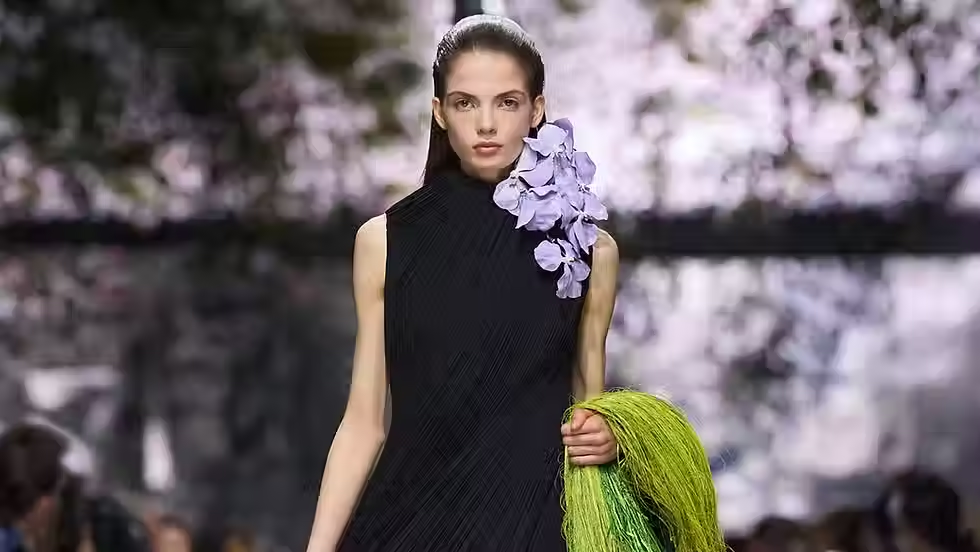
The collection included translucent suits, streamlined tunics, softly constructed coats, bias-cut evening dresses and familiar Chanel silhouettes transformed through exceptional materials and workmanship. Even when garments incorporated vines, butterflies, floral motifs or fairy-tale creatures, their foundations remained recognisable and functional. (AP News)
Blazy has repeatedly emphasised the importance of creating clothes that people genuinely want to wear. At Chanel, this philosophy connects naturally with Gabrielle Chanel’s original challenge to restrictive fashion: she designed for movement, independence and women’s changing lives. (Le Monde.fr)
In this collection, wearability did not diminish the couture experience. Instead, it made the fantasy more convincing. The extraordinary appeared within the familiar—a tiny narrative hidden inside a jacket, an embroidered creature travelling across a dress or a golden object emerging from an otherwise restrained silhouette.

The Chanel Suit Becomes Weightless
The Chanel suit remained one of the collection’s essential foundations, but Blazy continued to loosen its traditional structure.
Jackets and skirts appeared in sheer mousseline, delicate embroideries and almost transparent layers, creating the impression that the house’s most recognisable uniform had been transformed into a memory of itself.
The result was neither a rejection of Chanel’s heritage nor a faithful reproduction of it. Blazy preserved the suit’s visual language while removing its expected weight.
This approach reflects one of the designer’s greatest strengths: his ability to recognise an iconic object, understand why it matters and then alter its emotional effect. Under his direction, familiar Chanel codes can feel intimate, imperfect and alive rather than preserved behind glass.
Couture Told Through Details
Although the Grand Palais set provided an immediate visual spectacle, much of the collection’s true richness existed at a smaller scale.
Fairy tales were embedded into buttons, linings, footwear, jewellery and bags. Transparent dresses were embroidered with climbing vines. Some garments appeared to be constructed from straw, recalling scarecrows and rural folklore, while butterflies and flowers introduced themes of change, fragility and renewal. (english.aawsat.com)
These details demonstrated the importance of Chanel’s specialist ateliers. Embroidery, featherwork, textile development, jewellery and accessory-making allowed Blazy’s imaginary world to materialise through human skill.
Across the Fall/Winter 2026–2027 couture season, craftsmanship emerged as a wider industry priority. At Chanel, however, craft was not presented only as technical virtuosity. It functioned as storytelling: every handmade surface could contain a character, a transformation or a private joke. (Town & Country)
The Grand Palais as an Enchanted Garden
The Grand Palais became an exaggerated storybook landscape populated by towering flowers and an enormous beanstalk.
The scale of the installation evoked Jack and the Beanstalk, but its atmosphere was not entirely innocent. The oversized vegetation could feel beautiful, surreal and slightly unsettling at the same time—a reminder that traditional fairy tales often contain danger alongside wonder. (AP News)
This darker quality separated the show from a purely nostalgic vision of childhood. Blazy was not attempting to recreate innocence. Instead, he used fairy tales as frameworks through which ambition, transformation, vulnerability and independence could be reconsidered.
Gabrielle Chanel’s own rise—from an impoverished childhood to the creation of one of fashion’s most influential houses—became the collection’s most meaningful transformation story.
For Blazy, Chanel herself was the true fairy-tale heroine: a woman who changed her circumstances by making clothes for real women. (The Guardian)

No Bride, No Conventional Happy Ending
Traditionally, a haute couture presentation may conclude with a bridal look. Blazy rejected that expectation.
Instead, the show ended with an understated black off-the-shoulder dress. Several reports interpreted the finale as a Chanel “revenge dress”—a symbol of autonomy that replaced the conventional bride with a woman defined by her own power. (Vanity Fair)
The decision gave the collection its clearest message.
This fairy tale did not end with marriage. It ended with independence.
The finale also returned the collection to one of Chanel’s most enduring contributions to fashion: the little black dress. However, within Blazy’s narrative, black was not simply an expression of Parisian sophistication. It became a visual statement about self-possession, freedom and the possibility of writing one’s own ending.
A More Inclusive Vision of Couture
The collection also challenged the idea that couture belongs only to youth or fantasy figures disconnected from real life.
A model in her fifties appeared in a vivid red sequined dress, reinforcing the show’s intergenerational perspective. The choice supported Blazy’s broader conviction that Chanel should dress real women rather than present a single, restrictive vision of femininity. (The Guardian)
This matters because couture often operates through images of idealisation. Blazy’s approach does not remove aspiration, but it expands who may inhabit it.
His Chanel woman can be romantic, practical, mature, mysterious, playful or independent. She does not need to become a fairy-tale archetype to participate in the fantasy.
How Blazy’s Chanel Couture Is Evolving
Blazy’s first Chanel couture collection, presented for Spring/Summer 2026, introduced a lighter world shaped by transformation, nature and dreamlike imagery. His second collection developed those ideas into a more complex narrative.
The fantasy became darker. The symbolism became more precise. The relationship between clothing and lived experience became clearer.
Rather than approaching Chanel couture as an opportunity for decorative excess, Blazy appears interested in emotional and material transformation. He asks what a Chanel suit might become when rendered transparent, what a lining can communicate privately and how an accessory can carry a childhood memory.
This is couture as both public performance and personal experience.
Why Chanel Haute Couture Fall/Winter 2026–2027 Matters
The collection matters because it proposes a form of modern couture that is imaginative without becoming detached from life.
Blazy understands that the value of haute couture lies not only in how many hours a garment requires or how spectacular it appears on a runway. Its value also lies in the connection between the object and the person who wears it.
Through fairy tales, he explored transformation. Through Chanel’s archive, he examined independence. Through the ateliers, he made imagination tangible.
The resulting collection respected the codes of the house while demonstrating that heritage can remain flexible. Chanel’s tweed, black dresses, costume jewellery and elegant daywear were not treated as fixed formulas. They became characters capable of entering new stories.
Final Thoughts
Matthieu Blazy’s second couture show for Chanel confirmed that his vision for the house is becoming increasingly confident.
The collection was whimsical, intricate and visually seductive, yet its most powerful idea was surprisingly direct: fantasy has meaning when it helps us see reality differently.
By transforming the Grand Palais into a dark enchanted garden, Blazy created the spectacle expected of Chanel couture. By filling the clothes with intimate stories and ending without the traditional bride, he also questioned what a modern fairy tale should promise.
At his Chanel, the ultimate happy ending is not rescue, perfection or marriage.
It is freedom.
Frequently Asked Questions
When was Matthieu Blazy’s second Chanel couture show presented?
The Chanel Haute Couture Fall/Winter 2026–2027 show was presented at the Grand Palais in Paris on 7 July 2026. (reutersconnect.com)
What inspired Chanel Haute Couture Fall/Winter 2026–2027?
The collection was inspired by a century-old book of fairy tales that had belonged to Gabrielle Chanel. Its stories influenced the show’s set, embroidery, accessories, buttons and hidden garment details. (The Guardian)
What were the collection’s standout details?
Highlights included ugly-duckling-to-swan buttons, climbing-vine embroidery, a golden bear minaudière, golden-egg heels, butterfly motifs and hand-painted fairy-tale scenes inside jacket linings. (The Guardian)
Why did the show not end with a bridal gown?
Blazy replaced the conventional couture bride with a black off-the-shoulder dress, creating a finale associated with independence and the enduring power of Chanel’s little black dress. (Vanity Fair)
Where did the Chanel couture show take place?
The collection was shown inside the Grand Palais in Paris, which was transformed into an enchanted landscape featuring giant flowers, climbing plants and a monumental beanstalk. (AP News)




Online (ไซด์ไลน์) communication has changed the way people build relationships. Through messages, video calls, and social platforms, two people can stay connected no matter how far apart they live. It creates space for daily conversation, emotional support, and shared experiences even across time zones. Many relationships begin online because it is easier to express thoughts honestly in writing before meeting in person. While it offers convenience and speed, it also requires trust, patience, and clear communication. When used well, online communication can strengthen understanding, deepen affection, and help people feel close in a modern digital world.