
Koichi Takada's National Museum of Qatar Gift Shops Turn Timber into a Landscape
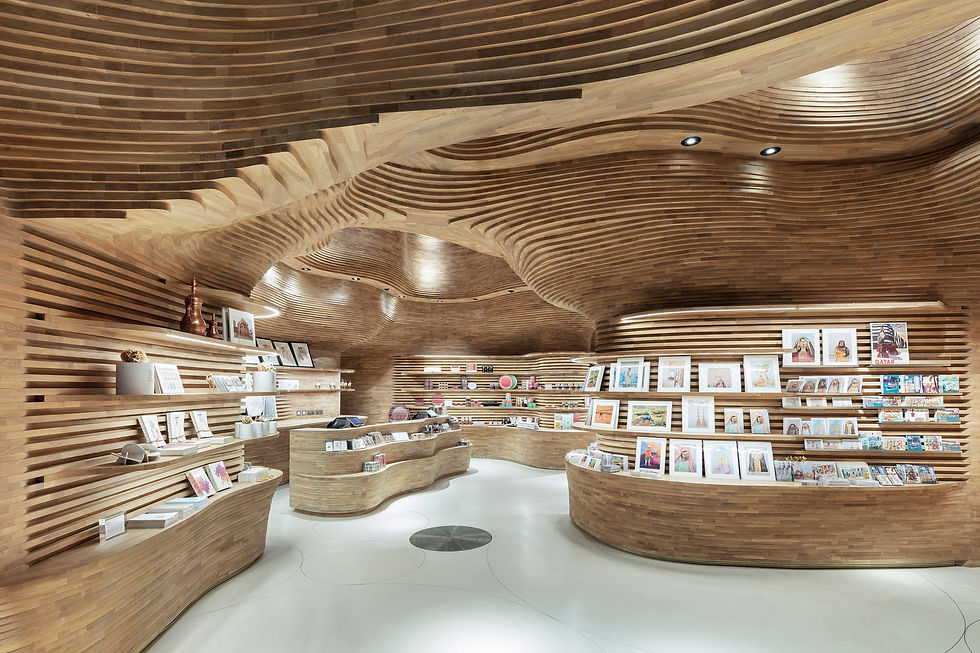
At the National Museum of Qatar in Doha, Koichi Takada Architects gave the gift shops an architectural presence of their own. Completed in March 2019, the main shop and children's shop occupy 174 and 97 square meters respectively. Within Jean Nouvel's museum, their curving timber surfaces create a distinct interior landscape, extending the visitor's encounter with Qatar into the space where objects and memories are taken home.
The commission is an unusually clear example of retail design carrying a cultural narrative. The shops offer merchandise, but the rooms also establish another way of looking at the country's natural environment. Their subject is a cave, interpreted through the material and fabrication possibilities of wood. [1]

The Cave of Light as a starting point
Takada's reference was Dahl Al Misfir, the Qatari formation known as the Cave of Light. Its gypsum crystals and luminous interior informed the shops' layered surfaces. The museum describes the result through the warm color and curves of the timber, connecting the design to a recognizable feature of the country's landscape.
The translation is deliberately spatial. Layers bend around the visitor and draw attention upward, making the enclosing surfaces active elements of the room. The geological reference supplies a way of organizing movement and perception. It also creates continuity with the museum's wider purpose: an encounter with place can happen through a designed environment as well as through an exhibit. [1] [2]

Forty thousand individual elements
The flowing appearance required an exacting construction process. Koichi Takada Architects records approximately 40,000 unique pieces of sustainably sourced European oak, developed through three-dimensional modeling and cut in Italy. Each piece had a defined position in the larger assembly.
Engineering specialist RIMOND describes a fabrication workflow that connected the geometry to CNC manufacturing while incorporating tolerances and construction details. This is the technical counterpart to the interior's geological imagery: a surface that appears continuous depends on thousands of individually controlled components. The effect comes from the coordination of design information, machining and installation, each working at a different scale. [1] [4]
Making a living material fit
Joinery specialist Devoto Design adds another layer to the story. Takada requested solid wood, and the fabricator proposed finger-jointed panels to help manage stability. The cladding was carried by its own support structure, allowing the timber composition to be installed without fixing it directly to the museum's existing walls.
Devoto's account also documents an adjustment during installation: the larger shop ultimately used 299 timber layers in place of the 300 initially anticipated, with the final layer remodeled to accommodate the material's behavior. That detail makes the craftsmanship tangible. Even a digitally defined interior must respond to physical conditions, and successful execution includes the ability to adjust a design intelligently on site. [5]
Keeping the shop in the picture
The museum identifies a different retail role for each space. The main gift shop carries objects connected to Qatar's history and culture, while the children's shop offers books, puzzles, games and educational toys. These everyday activities give the sculptural enclosure a practical setting: browsing, choosing and discussing an object remain the reasons people use the room.
The project's interest lies in the relationship between those modest actions and the scale of the surrounding timber. A museum shop can be a final pause in a visit, and here that pause has a memorable architectural identity. Takada's design gives the retail interior a subject, while the fabrication team gives that subject a convincing physical form. An interior of this kind asks visitors to shift repeatedly between an enveloping architectural scale and the much smaller scale of an object in the hand. [2] [3]


Comments