Egyptian Faience and the Design of Brightness
From Djoser’s wall tiles to William the hippopotamus, Egyptian faience used engineered color to join material, image, and form.
The blue hippopotamus known as William makes a landscape out of its own body. Lotus plants spread across its rounded flanks, placing the animal inside the marshes it inhabited. The Metropolitan Museum of Art dates the figure to about 1961–1878 BCE and explains the flowers as signs of regeneration. Seen through a design lens, the remarkable move is the compression: animal, habitat, and hoped-for renewal occupy the same small surface.

Hippopotamus (William), ca. 1961–1878 BCE. Three legs are restored. The Metropolitan Museum of Art, Gift of Edward S. Harkness, 1917. Public Domain / CC0. Collection · CC0 · Image policy
Ten photographed faience objects in The Metropolitan Museum of Art collection show different periods, forms and uses. Museum dates and recorded restorations are retained in the captions.
Egyptian faience gave that surface a particular kind of presence. A ceramic based on silica rather than a conventional clay body, it combined quartz with alkaline salts, lime, and colorants; copper produced its characteristic turquoise blue. Its porous core and glassy exterior behaved differently in light. Beneath the translucent glaze, irregular quartz particles scattered illumination, creating an appearance of depth. The color therefore depended on the relationship between layers. Calling it simply a blue coating misses the material construction responsible for the effect. The paste was difficult to shape: it could slump when worked, crack when bent, and struggled to support its own weight. That resistance makes the range of surviving forms more compelling. A desired appearance had to be negotiated through a material with awkward working properties.
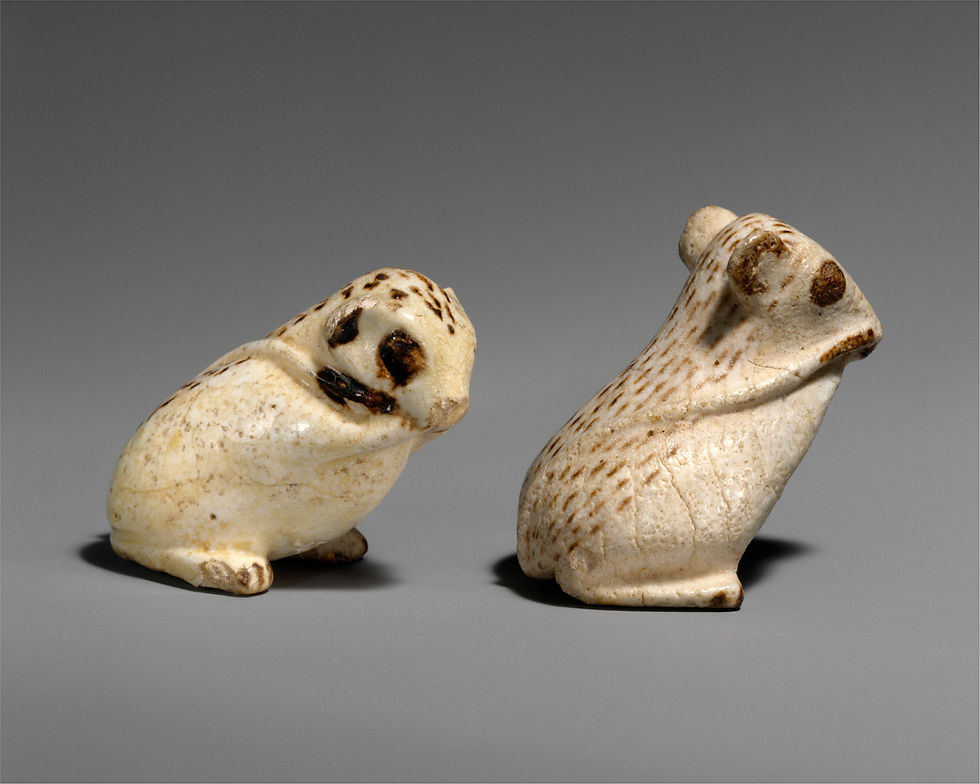
Jerboa figurine, ca. 1850–1640 BCE. The photograph shows two figurines; accession 26.7.899 identifies only the jerboa. The Metropolitan Museum of Art, Purchase, Edward S. Harkness Gift, 1926. Public Domain / CC0. Collection · CC0 · Image policy

Bes-Image Amulet, ca. 1080–721 BCE. Later form comparison. The Metropolitan Museum of Art, Purchase, Edward S. Harkness Gift, 1926. Public Domain / CC0. Collection · CC0 · Image policy
A surface built before firing
That construction began before the kiln. In the efflorescence method, ingredients in the wet mixture migrated outward as it dried, and firing converted the resulting surface layer into glaze. Other approaches buried the object in glazing powder or applied glaze directly. Each process made the finished exterior depend on decisions taken while the object was still unfinished. The surface can be read as a record of how the maker organized material transformation, even when its brightness initially hides that work.

Inlay Depicting a Falcon with Spread Wings, 4th century BCE. Later material comparison; glazing method unconfirmed. The Metropolitan Museum of Art, Purchase, Edward S. Harkness Gift, 1926. Public Domain / CC0. Collection · CC0 · Image policy
William also shows how cautiously such a record must be read. The Met's conservators found evidence consistent with more than one glazing method and left open the possibility of a combination. Radiography revealed a dense layer beneath the glaze, probably made with finer, whiter quartz and presumably intended to influence its optical qualities. They also documented modern restoration. Those qualifications matter. A beautiful surviving surface does not give us an uninterrupted view of either an ancient recipe or an ancient object's original condition.

Hippopotamus, ca. 1850–1640 BCE. A different hippopotamus from William; its glaze has discoloured. The Metropolitan Museum of Art, Rogers Fund, 1915. Public Domain / CC0. Collection · CC0 · Image policy
From the wall to the body
At architectural scale, faience carried a different design problem. Tiles from the funerary apartments of Djoser, dated around 2630–2611 BCE, were installed between limestone ledges under the Step Pyramid and in the Southern Tomb. Their arrangement imitated the reed matting of the king's palace. Here a familiar, relatively vulnerable enclosure was translated into a durable funerary setting. Repetition gives the little units their force: the eye reads a continuous wall treatment while the individual pieces preserve a rhythm of joints and rounded edges. The material helped make a remembered interior conceivable in another world.

Wall tiles from the funerary apartments of King Djoser, ca. 2630–2611 BCE. The Metropolitan Museum of Art, Rogers Fund, by exchange, 1948. Public Domain / CC0. Collection · CC0 · Image policy
The Broad Collar of Wah brings that relationship between unit and whole back to the body. Made around 1981–1975 BCE, it uses beads of diminishing lengths to achieve its curve; much of the original stringing survives. The collar belonged to Wah's funerary jewelry and was recovered among his mummy wrappings. Its geometry is a useful lesson in assembly. A broad, curved field emerges from small components whose lengths have been adjusted to their position. The overall contour is designed through the sequence of parts, and the luminous material gives those parts a shared visual identity.

Broad Collar of Wah, ca. 1981–1975 BCE. The Metropolitan Museum of Art, Rogers Fund and Edward S. Harkness Gift, 1940. Public Domain / CC0. Collection · CC0 · Image policy

Shabti of Seti I, ca. 1299–1290 BCE. Later funerary comparison, separate from Wah’s burial group. The Metropolitan Museum of Art, Purchase, Edward S. Harkness Gift, 1926. Public Domain / CC0. Collection · CC0 · Image policy
A material with different tasks
A later lotiform chalice, dated around 945–664 BCE, organizes its surface as a layered world. The Met connects its flower shape and relief scenes with creation, royal birth, and renewal around the Nile's inundation. Fish, reeds, papyrus, people, and animals populate the decoration. As a visual argument, the vessel joins its silhouette to its imagery: the blossom-like form holds a miniature marsh. Following its relief around the bowl asks for a different kind of attention from the collar's immediate sweep or the tiled wall's repeated rhythm.

Lotiform Chalice, ca. 945–664 BCE. The Metropolitan Museum of Art, Purchase, Edward S. Harkness Gift, 1926. Public Domain / CC0. Collection · CC0 · Image policy

Crocodile amulet, 305–246 BCE. Later animal-form comparison, distinct from the chalice. The Metropolitan Museum of Art, Gift of Norbert Schimmel Trust, 1989. Public Domain / CC0. Collection · CC0 · Image policy
These objects span very different periods and uses; grouping them by material should not flatten those differences. What the comparison reveals is the range of design work a surface can perform. It can establish a setting, coordinate separate parts, or turn a volume into an image. Egyptian faience makes especially visible the connection between those effects and the substance beneath them. Its brightness was made, and then put to work within particular objects and beliefs. Looking closely means attending to both achievements: the technical construction of an appearance and the choices that gave that appearance something to do.
The objects in detail
Ten photographed faience objects in The Metropolitan Museum of Art collection show different periods, forms and uses. Museum dates and recorded restorations are retained in the captions.
1. Hippopotamus (William), ca. 1961–1878 BCE. Faience with painted lotus decoration. Three legs are restored. The Metropolitan Museum of Art, Gift of Edward S. Harkness, 1917 (17.9.1). Image: The Metropolitan Museum of Art, CC0. CC0 licence.
2. Wall tiles from the funerary apartments of King Djoser, ca. 2630–2611 BCE. Faience. The Metropolitan Museum of Art, Rogers Fund, by exchange, 1948 (48.160.1). Image: The Metropolitan Museum of Art, CC0. CC0 licence.
3. Broad Collar of Wah, ca. 1981–1975 BCE. Faience and linen thread. The Metropolitan Museum of Art, Rogers Fund and Edward S. Harkness Gift, 1940 (40.3.2). Image: The Metropolitan Museum of Art, CC0. CC0 licence.
4. Lotiform Chalice, ca. 945–664 BCE. Faience. The Metropolitan Museum of Art, Purchase, Edward S. Harkness Gift, 1926 (26.7.971). Image: The Metropolitan Museum of Art, CC0. CC0 licence.
5. Inlay Depicting a Falcon with Spread Wings, 4th century BCE. Faience. The Metropolitan Museum of Art, Purchase, Edward S. Harkness Gift, 1926 (26.7.991). Image: The Metropolitan Museum of Art, CC0. CC0 licence.
6. Bes-Image Amulet, ca. 1080–721 BCE. Faience. The Metropolitan Museum of Art, Purchase, Edward S. Harkness Gift, 1926 (26.7.878). Image: The Metropolitan Museum of Art, CC0. CC0 licence.
7. Jerboa figurine, ca. 1850–1640 BCE. The primary collection photograph depicts two figurines; the catalogued object is accession 26.7.899. The Metropolitan Museum of Art, Purchase, Edward S. Harkness Gift, 1926 (26.7.899). Image: The Metropolitan Museum of Art, CC0. CC0 licence.
8. Crocodile amulet, 305–246 BCE. Faience. The Metropolitan Museum of Art, Gift of Norbert Schimmel Trust, 1989 (1989.281.96). Image: The Metropolitan Museum of Art, CC0. CC0 licence.
9. Shabti of Seti I, ca. 1299–1290 BCE. Faience and paint. The Metropolitan Museum of Art, Purchase, Edward S. Harkness Gift, 1926 (26.7.919). Image: The Metropolitan Museum of Art, CC0. CC0 licence.
10. Hippopotamus, ca. 1850–1640 BCE. The museum notes that its faience glaze has discolored over time. The Metropolitan Museum of Art, Rogers Fund, 1915 (15.3.199). Image: The Metropolitan Museum of Art, CC0. CC0 licence.


Comments