At Vienna's MAK, Architectural Construction Kits Become a Hands-On Design History
The MAK in Vienna explores a century of architectural building kits with replicas, eight play stations and a close look at how construction systems shaped design education.
Architecture often begins with an act of imagination, but it also depends on a surprisingly practical question: how do separate pieces hold together? At Vienna's MAK – Museum of Applied Arts, that question is being explored through the history of architectural construction kits, a category of design that sits somewhere between toy, model, teaching tool and experiment. The exhibition "Architectural Construction Kits 1890–1990," which opened on 7 October 2026 and runs until 14 March 2027, invites visitors not only to examine objects but to build with them.

MAK Ausstellungsansicht, 2026. ARCHITEKTURBAUKÄSTEN 1890–1990. Die große Mitspielausstellung. MAK Kunstblättersaal. © MAK/Christian Mendez. MAK source · Press-use terms
Museum press images accompany current editorial coverage of Architectural Construction Kits 1890–1990 at the MAK. The supplied object identifications, captions and individual copyright credits are retained under the museum’s press-use conditions.
A century of construction systems
Presented as an exhibition by the Deutsches Architekturmuseum (DAM), the Vienna show draws on the private collection of graphic designer Claus Krieger. The museum describes a collection of approximately 150 kits covering a century of experimentation in miniature architecture. What makes the selection compelling is not simply the nostalgia of assembling a small building; it is the way the kits reveal changing ideas about engineering, materials, education and the city itself.

MAK Ausstellungsansicht, 2026. ARCHITEKTURBAUKÄSTEN 1890–1990. Die große Mitspielausstellung. MAK Kunstblättersaal. © MAK/Christian Mendez. MAK source · Press-use terms

MAK Ausstellungsansicht, 2026. ARCHITEKTURBAUKÄSTEN 1890–1990. Die große Mitspielausstellung. MAK Kunstblättersaal. © MAK/Christian Mendez. MAK source · Press-use terms
Before any structure can rise, its pieces need a logic. Some historical manufacturers experimented with artificial brick or timber, while others pursued metal, rubber or materials that now seem almost forgotten, including Galalith. Different connections produce different possibilities: one system privileges easy repetition, another suggests a more intricate imitation of masonry, and a third encourages forms that may not resemble ordinary buildings at all. The history of construction toys can therefore be read as an informal history of design constraints.

Spranger-Baukasten, C. Gustav Spranger, Baukastenfabrik Klingenthal i. Sa., Deutschland (Sachsen), ca. 1930. © Sammlung Claus Krieger. MAK source · Press-use terms
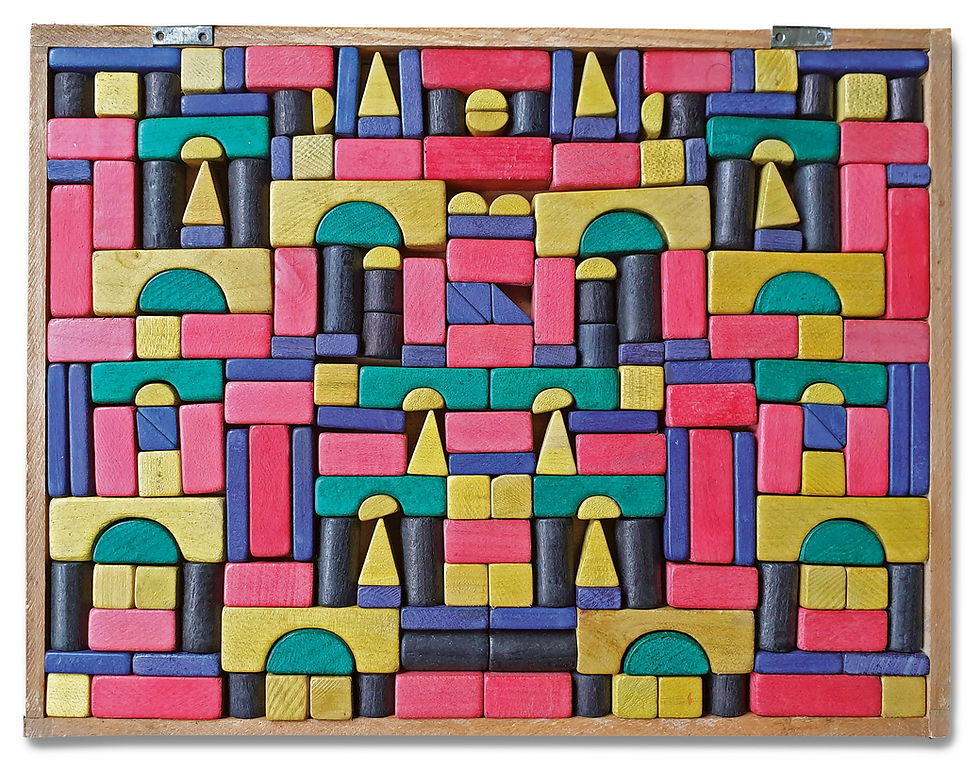
Les Bois de Megève, Jeu de Constructions, Frankreich, ca. 1930. © Sammlung Claus Krieger. MAK source · Press-use terms
Learning by building
The exhibition's interactive approach is central to that argument. According to the MAK, eight stations across the museum make it possible for visitors to handle building components and test ideas. These are not simply opportunities to touch fragile originals. Selected historic systems have been recreated specifically for participation. Students at HFT Stuttgart produced enlarged interpretations of the Ingenius, Bâtiss and Skyline systems, allowing visitors to investigate methods that would otherwise remain behind glass. Other stations reference systems such as Minibrix, Tetek and Dusyma, as well as a former East German construction kit.

MAK Ausstellungsansicht, 2026. ARCHITEKTURBAUKÄSTEN 1890–1990. Die große Mitspielausstellung. DIREKTION FÜR ALLE! © MAK/Christian Mendez. MAK source · Press-use terms

MAK Ausstellungsansicht, 2026. ARCHITEKTURBAUKÄSTEN 1890–1990. Die große Mitspielausstellung. Plaspi – Der kleine Großblock-Baumeister, VEB Gothaer Kunststoffverarbeitung, DE (Thüringen), ca. 1980. MAK Kunstblättersaal. © MAK/Christian Mendez. MAK source · Press-use terms
That difference between viewing and making is important. A finished miniature cathedral may suggest a clear outcome, but the experience of trying to make pieces fit exposes the countless decisions concealed within it. Scale, tolerances, repeated parts and the stability of connections become tangible. For children, this may be play; for adults, it can be a reminder that even apparently simple architecture requires a grammar of materials and assembly. The museum describes the exhibition as suitable for visitors aged four and above, though its subject extends far beyond a children's activity.

MAK Ausstellungsansicht, 2026. ARCHITEKTURBAUKÄSTEN 1890–1990. Die große Mitspielausstellung. Kathedrale aus ca. 4.000 Architecto-Bausteinen, hergestellt aus recycelten PET-Flaschen. MAK Säulenhalle. © MAK/Stella Riessland. MAK source · Press-use terms
Models, scale and experience
A virtual-reality component offers another route into model architecture. The combination of physical building blocks and an immersive digital experience also creates an interesting contrast: construction kits teach through resistance and contact, while digital models allow viewers to move through spaces at a different scale. Neither replaces the other. Together, they can reveal what designers gain—and lose—when moving between representation and construction.
Guest curator Oliver Elser of the DAM places these objects within a broader historical development. Rather than treating modern interlocking bricks as the inevitable beginning of construction play, the exhibition reminds visitors that many ingenious systems preceded the most familiar contemporary formats. Several once-promising approaches disappeared, while others influenced how generations learned to plan, assemble and imagine spaces.

MAK Ausstellungsansicht, 2026. ARCHITEKTURBAUKÄSTEN 1890–1990. Die große Mitspielausstellung. American Skyline-Baukasten, Elgo Plastics Inc., USA, 1950er–1960er Jahre. MAK Kunstblättersaal. © MAK/Christian Mendez. MAK source · Press-use terms
Experimentation in the museum
In the context of a design museum, that story becomes especially timely. Architectural models are often presented as polished evidence of a project, not as provisional tools for understanding the limits of an idea. The MAK turns the process around. By asking visitors to make and remake forms, it brings attention back to experimentation, failure, repair and the pleasure of discovering how something works.

MAK Ausstellungsansicht, 2026. ARCHITEKTURBAUKÄSTEN 1890–1990. Die große Mitspielausstellung. MAK Säulenhalle 1. Stock. © MAK/Christian Mendez. MAK source · Press-use terms
"Architectural Construction Kits 1890–1990" is at the MAK in Vienna from 7 October 2026 until 14 March 2027. Dates, visitor access and the education programme should be checked on the museum's official website before visiting.


Comments