A Writing Kit, Painted on Every Side: The Persian Penbox
The Persian qalamdan turns a narrow container into a carefully sequenced encounter with writing tools, painted landscapes and the prestige of the written word.
A penbox asks a designer to work with an unusually insistent proportion: a long, narrow body determined by the tools it contains. On Persian lacquer examples, that constraint becomes the basis of the decoration. A branch can run lengthwise, a landscape can extend around an end, and a sliding tray can reveal another painted surface. The object offers no single, complete view. Its design unfolds through handling, making a small piece of writing equipment into a succession of visual encounters.

Sani' Humayun, Lacquer Pen Box with Royal Audience Scenes, dated 1314 AH/1896–97 CE. Purchase, 2017 and 2018 NoRuz at The Met Benefits, 2023. The Metropolitan Museum of Art. Public Domain, CC0. Collection · CC0 · Image policy
Ten distinct museum photographs follow two Persian penboxes through their exterior, interior, separate components and painted details.

Sani' Humayun, Lacquer Pen Box with Royal Audience Scenes, dated 1314 AH/1896–97 CE. Partly opened tray. Purchase, 2017 and 2018 NoRuz at The Met Benefits, 2023. The Metropolitan Museum of Art. Public Domain, CC0. Collection · CC0 · Image policy
Ten distinct museum photographs follow two Persian penboxes through their exterior, interior, separate components and painted details.
The relationship with actual tools survives particularly clearly in a Harvard Art Museums object catalogued as a Pen Box with Three Reed Pens and Inkwell. Made in Iran in 1862–63, during the Qajar period, its case bears the signature of Abu Talib al-Mudarris. The museum record gives a length of 21.59 centimetres. This is a useful corrective to treating every elaborate penbox as miniature painting alone: the named components place the case within the practical equipment of writing, even when its original pattern of daily use is unknown.

Haji Muhammad, Pen Box with a Europeanizing Landscape, late 17th–early 18th century. Case, tray and fittings; comparison, distinct from Harvard’s 1862–63 writing kit. Purchase, Elizabeth S. Ettinghausen Gift, in memory of Richard Ettinghausen, 2000. The Metropolitan Museum of Art. Public Domain, CC0. Collection · CC0 · Image policy
The Metropolitan Museum of Art's account of Iranian lacquer provides a wider context for these objects. Production expanded during the eighteenth and nineteenth centuries, when painted lacquerwares were commissioned by elite patrons, sold commercially and exported. The museum also describes a popular decorative vocabulary known as gul-u-bulbul, in which birds appear among branches, foliage and flowering fruit. Such imagery belongs to a particular material and commercial history. The penbox gave painters one compact format within a much wider field of lacquer production.
A narrow field for painting
In a bird-and-flower composition, the narrow format can become productive. Stems supply continuity while birds and blossoms create points of attention. The format encourages the eye to travel rather than settle on a large central field. That reading does not depend on assigning a symbolic meaning to every creature. It begins with something more directly visible: the painter has to manage intervals, turns and changes of direction on a container with very little width. The enclosure becomes a framework for pictorial rhythm.

Haji Muhammad, Pen Box with a Europeanizing Landscape, late 17th–early 18th century. Closed exterior. Purchase, Elizabeth S. Ettinghausen Gift, in memory of Richard Ettinghausen, 2000. The Metropolitan Museum of Art. Public Domain, CC0. Collection · CC0 · Image policy
Another Met penbox, signed by Haji Muhammad and dated to the late seventeenth or early eighteenth century, introduces a landscape on the inside cover. The museum connects its Europeanizing character to the artist and his family, including his brother Muhammad Zaman. It also places the object within the high esteem accorded to calligraphy and writing in the Islamic world. Here, opening the equipment changes the visual register. An internal surface receives a considered image, so decoration continues beyond the view available when the box is closed.

Haji Muhammad, Pen Box with a Europeanizing Landscape, late 17th–early 18th century. Open case and interior landscape. Purchase, Elizabeth S. Ettinghausen Gift, in memory of Richard Ettinghausen, 2000. The Metropolitan Museum of Art. Public Domain, CC0. Collection · CC0 · Image policy

Haji Muhammad, Pen Box with a Europeanizing Landscape, late 17th–early 18th century. Interior-landscape detail of the same Haji Muhammad box. Purchase, Elizabeth S. Ettinghausen Gift, in memory of Richard Ettinghausen, 2000. The Metropolitan Museum of Art. Public Domain, CC0. Collection · CC0 · Image policy
The distinction between exterior and interior matters. A case must have an edge, a seam and some means of access; these are usually treated as interruptions to an image. In a penbox they can also establish its sequence. The outside is encountered first, the inside later, and the tray supplies another plane to inspect. From a design perspective, that is a way of organising attention through construction. It need not imply that every surviving example was constantly carried, or that every elaborate case was used in the same way.

Sani' Humayun, Lacquer Pen Box with Royal Audience Scenes, dated 1314 AH/1896–97 CE. Separated case and tray; imperial comparison with Haji Muhammad’s box. Purchase, 2017 and 2018 NoRuz at The Met Benefits, 2023. The Metropolitan Museum of Art. Public Domain, CC0. Collection · CC0 · Image policy
An imperial presentation
Sani' Humayun's imperial penbox of 1896–97 makes the sequence especially explicit. The Met records paintings across the frame, sides, underside and the interior of its sliding drawers. Royal audiences featuring historical and legendary Iranian rulers, principally from the Shahnama, occupy the box; Sufi subjects appear on the tray. The museum identifies this type as a presentation object for the shah, the court and wealthy patrons. Its decorative density therefore has a documented social setting, beyond the general pleasure of ornamenting a useful thing.

Sani' Humayun, Lacquer Pen Box with Royal Audience Scenes, dated 1314 AH/1896–97 CE. Interior of the same imperial penbox. Purchase, 2017 and 2018 NoRuz at The Met Benefits, 2023. The Metropolitan Museum of Art. Public Domain, CC0. Collection · CC0 · Image policy
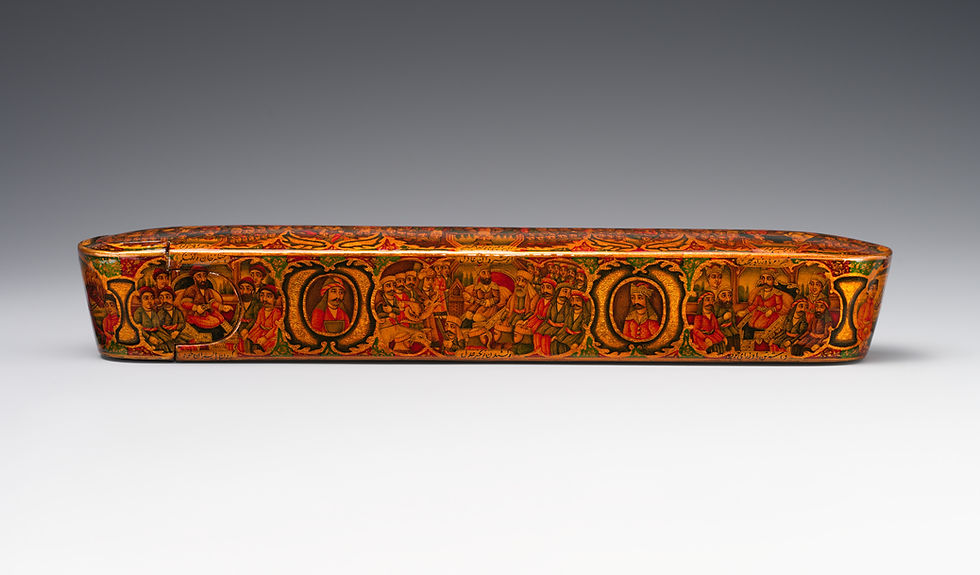
Sani' Humayun, Lacquer Pen Box with Royal Audience Scenes, dated 1314 AH/1896–97 CE. Outer side of the same imperial penbox. Purchase, 2017 and 2018 NoRuz at The Met Benefits, 2023. The Metropolitan Museum of Art. Public Domain, CC0. Collection · CC0 · Image policy
These examples caution against a single story of the Persian penbox. A flower-covered case, an interior landscape and an imperial presentation piece share a basic category without having identical purposes or audiences. Their common design problem is more specific: how to give a narrow, fitted container a compelling visual presence. Each finds room for variation within a limited envelope. The dimensions help explain why details, small transitions and the relation between adjoining surfaces carry so much of the experience.

Sani' Humayun, Lacquer Pen Box with Royal Audience Scenes, dated 1314 AH/1896–97 CE. Curved-end view of the same imperial penbox. Purchase, 2017 and 2018 NoRuz at The Met Benefits, 2023. The Metropolitan Museum of Art. Public Domain, CC0. Collection · CC0 · Image policy
The qalamdan's lasting interest lies in that closeness between equipment and image. Its decoration can acknowledge writing's cultural importance while its form continues to answer the scale of the tools. Looking at the whole object means following a seam as carefully as a painted branch, and giving the revealed tray the same attention as the outer shell. Compact storage, in these examples, becomes an art of arranging what is held, what is seen and what becomes visible next.


Comments