
The Pharmacy Shelf as a Work of Design
Renaissance Italian albarelli joined graspable shapes with painted information, turning the crowded pharmacy shelf into a coordinated display.
The slight waist of a Renaissance pharmacy jar is a small design decision with a large effect. It gives the hand somewhere to close while neighbouring vessels crowd the shelf. Look beyond the painted portraits and curling foliage, and the Italian albarello begins to read as equipment made for repeated handling. Its decoration belongs to that practical setting too: a pharmacy had to store substances, distinguish containers and present an intelligible display of its stock.

Albarello, ca. 1480. The Metropolitan Museum of Art, Fletcher Fund, 1946. Public Domain / CC0. Collection · CC0 · Image policy
Ten photographed historical pharmacy jars in The Metropolitan Museum of Art collection. The gallery compares distinct objects and pairs rather than presenting a reconstruction of one pharmacy.
The Metropolitan Museum of Art describes these storage vessels as commonly produced in relatively standard forms, designed to sit alongside dozens of others. Handles generally stayed within the vessel’s profile, while the cylindrical albarello narrowed around the middle for a better grip. Flanged lips helped secure cloth or paper closures. Considered together, these details show a design negotiating two competing demands: the jars needed to pack closely, but each still had to be reachable and removable. The space between objects was part of the problem.
Containers that communicate
The closure deserves as much attention as the painted body. Cleveland Museum of Art’s pharmacy jar of about 1475–80 has a flared lip that could hold parchment or cloth fastened with string. Its inscription suggests that it once contained a peony preparation. Such a vessel asks to be understood with its absent soft materials restored in the imagination. The ceramic survives; the covering usually does not. Today’s open museum silhouette can obscure how a jar functioned when filled and sealed on a working shelf.

Apothecary jar (albarello), 1480–1500. Related jar, distinct from Cleveland’s peony jar; original closure not shown. The Metropolitan Museum of Art, Robert Lehman Collection, 1975. Public Domain / CC0. Collection · CC0 · Image policy

Apothecary jar (albarello), ca. 1480–1500. Second comparative jar, distinct from Cleveland’s peony jar; a shared set is unproven. The Metropolitan Museum of Art, Robert Lehman Collection, 1975. Public Domain / CC0. Collection · CC0 · Image policy
Maiolica also supplied a surface for information. The Met’s glossary defines tin glaze as a glaze made opaque and white by tin oxide. That light surface offered painters a strong field for inscriptions and ornament. In design terms, a label could be incorporated into the same composition as an emblem or a portrait. The result raises a useful question when looking at any surviving jar: which marks named the contents, and which identified the place or people associated with the container?

Apothecary jar (albarello), ca. 1530–40. Portrait-and-inscription comparison; contents unidentified here. The Metropolitan Museum of Art, Robert Lehman Collection, 1975. Public Domain / CC0. Collection · CC0 · Image policy
A set with room for difference
A Montelupo jar of about 1500–1510 makes that distinction unusually clear. Its inscription, PIONIA, identifies an intended peony-based preparation. The flower displayed prominently above it should not automatically be read as an illustration of the ingredient. Timothy Wilson’s Met catalogue places the jar within a surviving series whose similar flowers may have represented the pharmacy’s emblem or shop sign. The proposed emblem stays consistent while the written contents change. To a design reader, that arrangement resembles the relationship between a shared identity and individual product information.
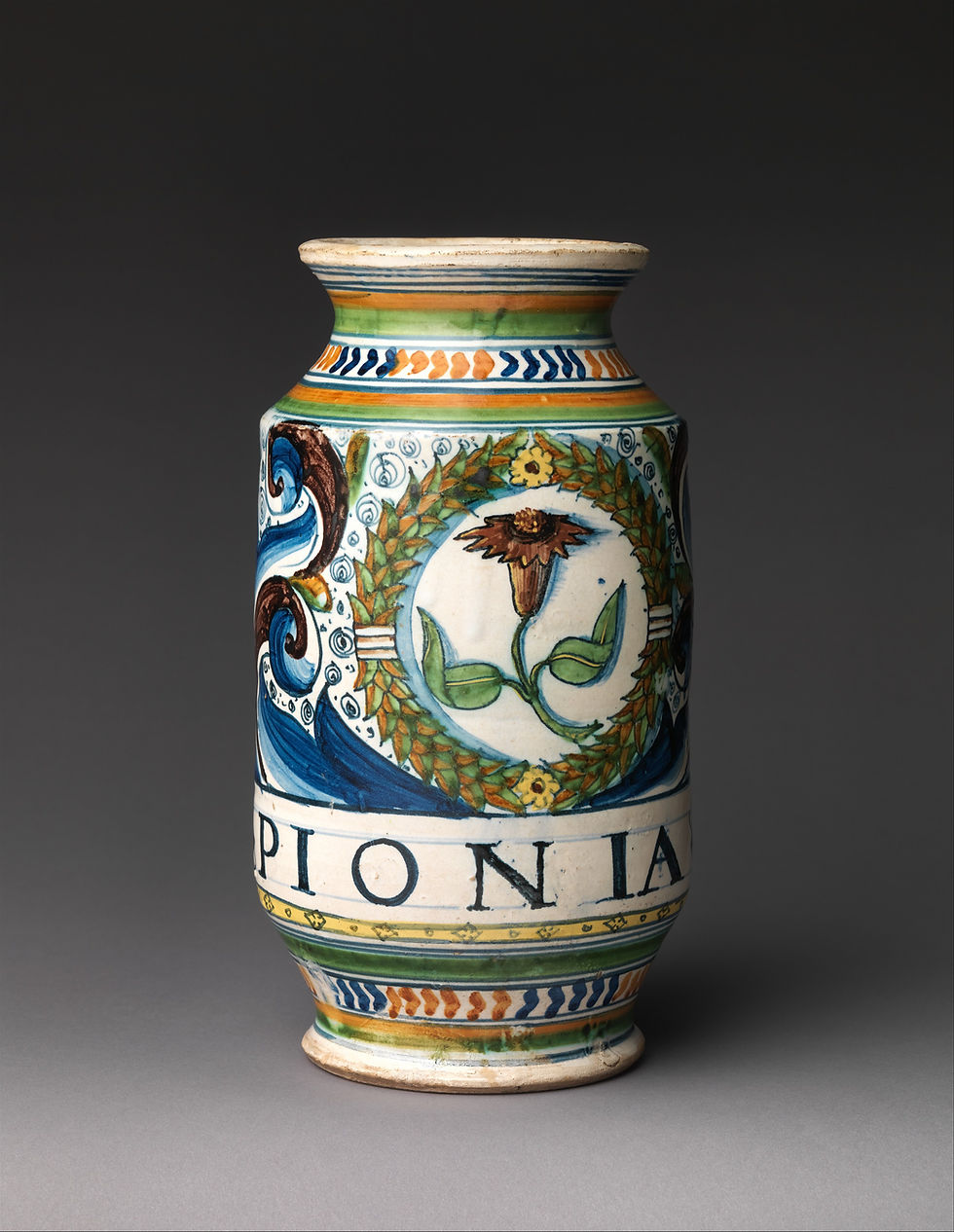
Pharmacy jar (albarello), Montelupo, ca. 1500–1510. PIONIA names intended contents; the flower’s emblematic role is proposed. The Metropolitan Museum of Art, Gift of J. Pierpont Morgan, by exchange, 1965. Public Domain / CC0. Collection · CC0 · Image policy
Other jars suggest identification without an explicit ingredient label. Two Met albarelli attributed to Naples or its surroundings, dated about 1475–1500, show different male profiles on their fronts. The museum proposes that their close similarity points to a common pharmacy set, and that the contrasting faces could have helped a merchant tell the jars apart. This remains an interpretation rather than proof of a standardized system. Even so, the pairing draws attention to a productive design balance: enough resemblance to belong together, enough difference to recognize one vessel.

Pharmacy jar (albarello), ca. 1475–1500. Attributed to Naples or surroundings; proposed common pharmacy set. The Metropolitan Museum of Art, Fletcher Fund, 1946. Public Domain / CC0. Collection · CC0 · Image policy

Pharmacy jar (albarello), ca. 1475–1500. Attributed to Naples or surroundings; second jar of a proposed set. The Metropolitan Museum of Art, Fletcher Fund, 1946. Public Domain / CC0. Collection · CC0 · Image policy
The shelf and the single object
The front and back were not necessarily given equal emphasis. A later pair, probably from the Naples district or Vietri sul Mare, carries similar female profiles on the fronts and simpler plant ornament behind. That division can be read as an economy of attention. The decorated face addresses the person approaching the shelf, while the rest of the vessel remains visually connected. This reading does not require assuming that every jar was always displayed in one position; it begins with the unequal treatment of its surfaces.

Pharmacy jar (albarello), ca. 1530–60. Probably Naples district or Vietri sul Mare; female-profile front. The Metropolitan Museum of Art, Gift of George Blumenthal, 1941. Public Domain / CC0. Collection · CC0 · Image policy

Pharmacy jar (albarello), ca. 1530–60. Probably Naples district or Vietri sul Mare; second female-profile front. The Metropolitan Museum of Art, Gift of George Blumenthal, 1941. Public Domain / CC0. Collection · CC0 · Image policy
A group probably made in Pesaro around 1579 demonstrates how ambitious a pharmacy identity could become. Five vessels at the Met share Fortuna standing over a sea monster, a motif the museum considers a likely identifier for their pharmacy. Differences reveal the participation of several painters. The series therefore holds together without mechanical sameness. Repeated imagery provides continuity, while individual handling and changing vessel shapes leave room for variation. The ceramic group can be understood as a coordinated display assembled from distinct painted objects.

Pharmacy jar (albarello) (one of a pair), ca. 1579. Probably Pesaro; one Fortuna-series jar, not the entire five-vessel group. The Metropolitan Museum of Art, Gift of Julia A. Berwind, 1953. Public Domain / CC0. Collection · CC0 · Image policy
These jars reward a shift in viewing distance. Close up, there are brushstrokes, faces and letterforms; farther away, there are outlines, intervals and repeated motifs. Their design exists at both scales. An albarello could be pleasing as a single painted object while participating in the ordered density of a pharmacy interior. Its most compelling lesson is the attention given to the whole sequence of use: finding a vessel, reaching for it, opening it and returning it to its neighbours.
The objects in detail
Ten photographed historical pharmacy jars in The Metropolitan Museum of Art collection. The gallery compares distinct objects and pairs rather than presenting a reconstruction of one pharmacy.
1. Pharmacy jar (albarello), Montelupo, ca. 1500–1510. The inscription PIONIA identifies its intended contents. The Metropolitan Museum of Art, Gift of J. Pierpont Morgan, by exchange, 1965 (65.6.4). Public Domain / CC0. CC0 licence.
2. Albarello, ca. 1480. Maiolica (tin-glazed earthenware). The Metropolitan Museum of Art, Fletcher Fund, 1946 (46.85.12). Public Domain / CC0. CC0 licence.
3. Pharmacy jar (albarello), ca. 1530–60. Maiolica (tin-glazed earthenware). The Metropolitan Museum of Art, Gift of George Blumenthal, 1941 (41.100.268). Public Domain / CC0. CC0 licence.
4. Pharmacy jar (albarello), ca. 1530–60. Maiolica (tin-glazed earthenware). The Metropolitan Museum of Art, Gift of George Blumenthal, 1941 (41.100.269). Public Domain / CC0. CC0 licence.
5. Pharmacy jar (albarello), ca. 1475–1500. Maiolica (tin-glazed earthenware). The Metropolitan Museum of Art, Fletcher Fund, 1946 (46.85.13). Public Domain / CC0. CC0 licence.
6. Pharmacy jar (albarello), ca. 1475–1500. Maiolica (tin-glazed earthenware). The Metropolitan Museum of Art, Fletcher Fund, 1946 (46.85.14). Public Domain / CC0. CC0 licence.
7. Pharmacy jar (albarello) (one of a pair), ca. 1579. Maiolica (tin-glazed earthenware). The Metropolitan Museum of Art, Gift of Julia A. Berwind, 1953 (53.225.84). Public Domain / CC0. CC0 licence.
8. Apothecary jar (albarello), ca. 1530–40. Maiolica (tin-glazed earthenware). The Metropolitan Museum of Art, Robert Lehman Collection, 1975 (1975.1.1048). Public Domain / CC0. CC0 licence.
9. Apothecary jar (albarello), 1480–1500. Maiolica (tin-glazed earthenware). The Metropolitan Museum of Art, Robert Lehman Collection, 1975 (1975.1.1116). Public Domain / CC0. CC0 licence.
10. Apothecary jar (albarello), ca. 1480–1500. Maiolica (tin-glazed earthenware). The Metropolitan Museum of Art, Robert Lehman Collection, 1975 (1975.1.1117). Public Domain / CC0. CC0 licence.


Comments