
Roman Mold-Blown Glass and the Design of Repetition
Hidden seams, signed surfaces, and worn molds reveal how Roman glassmakers built form and communication into a repeatable manufacturing process.
A seam can be one of the most revealing lines on a Roman glass vessel. On the Metropolitan Museum of Art's gladiator cup, dated about 50–80 CE, it runs down the sides and across the bottom. Palm fronds conceal its vertical sections. That small accommodation is a design decision worth noticing: the picture has been arranged around the requirements of manufacture. The finished object preserves the meeting between a decorative composition and the tool that gave it shape.

Glass gladiator cup, ca. 50–80 CE. Souvenir function is suggested, not established. The Metropolitan Museum of Art, Gift of Henry G. Marquand, 1881. Public Domain / CC0. Collection · CC0 · Image policy
Ten photographed Roman glass vessels from The Metropolitan Museum of Art collection. These are surviving historical objects, with their individual dates and manufacturing descriptions.
Mold-blowing required a cavity assembled from separate sections, allowing the vessel to be released after inflation. Recessed designs in the mold emerged as raised decoration in the glass. The blower inflated hot glass inside, removed the vessel, and continued shaping it, including its rim and any handles. The mold could then be reused. Design work was concentrated partly in a tool capable of passing its decisions onward. The same operation transferred a vessel's outline and surface detail, bringing those usually separate questions into close contact.

Glass bottle in the shape of a fish, 1st–2nd century CE. Separate moulded-form comparison. The Metropolitan Museum of Art, Gift of J. Pierpont Morgan, 1917. Public Domain / CC0. Collection · CC0 · Image policy

Glass bottle shaped like a bunch of grapes, 4th century CE. Later moulded-form comparison. The Metropolitan Museum of Art, Gift of J. Pierpont Morgan, 1917. Public Domain / CC0. Collection · CC0 · Image policy
The mold as a design tool
Ennion's honey-brown jug from the first half of the first century CE shows how elaborate that contact could become. Its neck and upper body were formed in three mold sections, with another section shaping the lower body and base. Fluting, palmettes, and a net pattern divide the surface into registers, interrupted by a framed Greek inscription. An opaque white handle contrasts with the translucent body. To a contemporary eye, the arrangement reads like a carefully ordered composition whose changes of density help distinguish one part of the vessel from the next.

Glass jug signed by Ennion, first half of the 1st century CE. The Metropolitan Museum of Art, Gift of J. Pierpont Morgan, 1917. Public Domain / CC0. Collection · CC0 · Image policy

Glass cup, first half of the 1st century CE. A separate Ennion vessel, with one surviving handle. The Metropolitan Museum of Art, Gift of J. Pierpont Morgan, 1917. Public Domain / CC0. Collection · CC0 · Image policy
The manufacturing method also made words repeatable. A beaker signed by Jason, dated to the middle of the first century CE, carries two Greek inscriptions: one identifies its maker; the other asks that its buyer be remembered. The Met describes it as probably made in the same mold as another surviving example. The inscription thus belongs to the repeatable design. It can suggest a relationship between maker and purchaser each time another vessel emerges. We can recognize that communicative ambition without assuming it operated exactly like a modern trademark.

Glass beaker signed by Jason, mid-1st century CE. The Metropolitan Museum of Art, H. O. Havemeyer Collection, Bequest of Mrs. H. O. Havemeyer, 1929. Public Domain / CC0. Collection · CC0 · Image policy
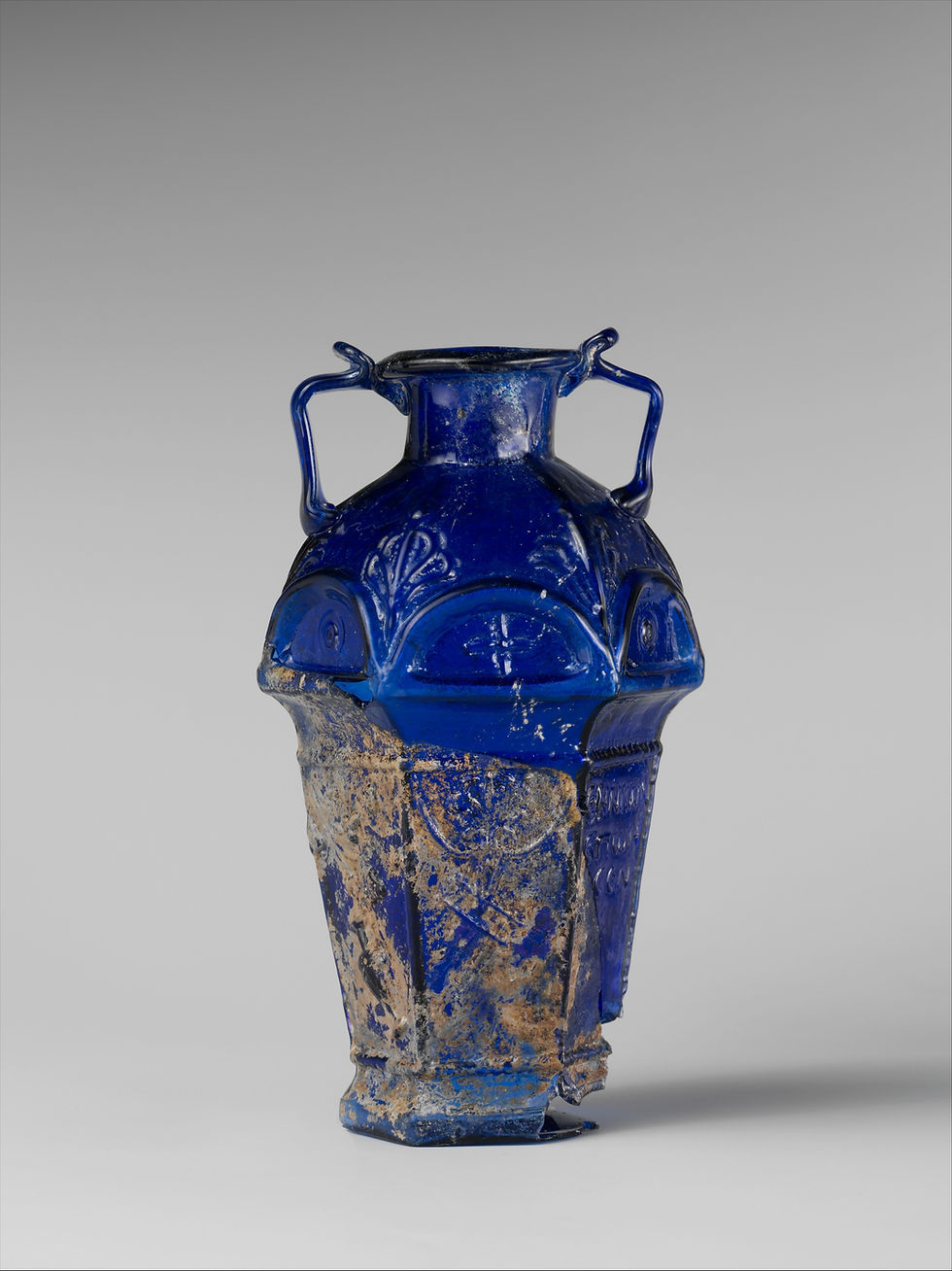
Glass hexagonal amphoriskos signed by Ennion, first half of the 1st century CE. Signed-Ennion comparison with Jason’s beaker. The Metropolitan Museum of Art, Gift of Henry G. Marquand, 1881. Public Domain / CC0. Collection · CC0 · Image policy
Images around a curved surface
Return to the gladiator cup and the audience becomes more specific. Its relief shows four pairs of combatants, identified by names. Some names correspond to gladiators known from games in Rome, leading the museum to suggest a souvenir function. The qualification is important: an event-specific sales history has not been established for this individual cup. Still, the design offers a striking arrangement of attention. Figures, labels, borders, and palm fronds divide a continuous curved surface into readable encounters. Turning the cup would reveal the composition in stages.

Glass bottle, 1st century CE. Separate curved-relief comparison, distinct from the gladiator cup. The Metropolitan Museum of Art, Gift of Henry G. Marquand, 1881. Public Domain / CC0. Collection · CC0 · Image policy
Repeatability served quieter purposes too. The Met's account of Roman mold-blown glass describes uniform storage containers as useful to merchants and purchasers. A rectangular bottle of the second or third century CE makes the practical side of the technique visible through flat walls, a compact body, and two broad handles. Its base carries a relief design that the catalogue tentatively relates to a standard or banner. Plainness and decoration coexist, with attention distributed unevenly across the container. What is most visible when it stands upright differs from what appears when it is lifted and turned.

Glass rectangular bottle, 2nd–3rd century CE. The Metropolitan Museum of Art, Gift of J. Pierpont Morgan, 1917. Public Domain / CC0. Collection · CC0 · Image policy
What repetition preserves
Molds also gave repetition a history of change. They wore out or broke; replacements could be newly made or copied from existing vessels. Such copying produced later generations with changes in size and detail. On a first-century hexagonal bottle in the Met, the catalogue identifies signs of a cracked and distorted mold in two decorated panels. The vessel is evidence of a production tool's condition as well as an example of its intended pattern. A series could transmit defects along with the features its maker wanted to preserve.

Glass hexagonal bottle, first half of the 1st century CE. The catalogue identifies evidence of mould damage. The Metropolitan Museum of Art, Gift of J. Pierpont Morgan, 1917. Public Domain / CC0. Collection · CC0 · Image policy
Calling this designed manufacture helps keep the whole sequence in view. Someone had to anticipate the finished object while working on a divided, negative form; the glassworker still had to handle hot material and finish the result. The surviving vessels invite us to look for where those activities meet. A concealed seam, an applied handle, a repeated inscription, or a weakened relief can each expose part of that relationship. Roman mold-blown glass makes repetition tangible while leaving enough variation to show that repetition itself had to be made.
The objects in detail
Ten photographed Roman glass vessels from The Metropolitan Museum of Art collection. These are surviving historical objects, with their individual dates and manufacturing descriptions.
1. Glass jug signed by Ennion, first half of the 1st century CE. Blown in a four-part mold; opaque white handle. The Metropolitan Museum of Art, Gift of J. Pierpont Morgan, 1917 (17.194.226). Image: The Metropolitan Museum of Art, CC0. CC0 licence.
2. Glass gladiator cup, ca. 50–80 CE. Blown in a two-part mold. The Metropolitan Museum of Art, Gift of Henry G. Marquand, 1881 (81.10.245). Image: The Metropolitan Museum of Art, CC0. CC0 licence.
3. Glass beaker signed by Jason, mid-1st century CE. Blown in a three-part mold. The Metropolitan Museum of Art, H. O. Havemeyer Collection, Bequest of Mrs. H. O. Havemeyer, 1929 (29.100.82). Image: The Metropolitan Museum of Art, CC0. CC0 licence.
4. Glass bottle in the shape of a fish, 1st–2nd century CE. Mold-blown glass. The Metropolitan Museum of Art, Gift of J. Pierpont Morgan, 1917 (17.194.251). Image: The Metropolitan Museum of Art, CC0. CC0 licence.
5. Glass bottle shaped like a bunch of grapes, 4th century CE. Blown in a two-part mold and trailed. The Metropolitan Museum of Art, Gift of J. Pierpont Morgan, 1917 (17.194.231). Image: The Metropolitan Museum of Art, CC0. CC0 licence.
6. Glass rectangular bottle, 2nd–3rd century CE. Mold-blown glass. The Metropolitan Museum of Art, Gift of J. Pierpont Morgan, 1917 (17.194.219). Image: The Metropolitan Museum of Art, CC0. CC0 licence.
7. Glass hexagonal bottle, first half of the 1st century CE. Blown in a three-part mold; the catalogue identifies evidence of mold damage. The Metropolitan Museum of Art, Gift of J. Pierpont Morgan, 1917 (17.194.228). Image: The Metropolitan Museum of Art, CC0. CC0 licence.
8. Glass cup, first half of the 1st century CE. An Ennion vessel blown in a four-part mold. The Metropolitan Museum of Art, Gift of J. Pierpont Morgan, 1917 (17.194.225). Image: The Metropolitan Museum of Art, CC0. CC0 licence.
9. Glass hexagonal amphoriskos signed by Ennion, first half of the 1st century CE. Blown in a four-part mold. The Metropolitan Museum of Art, Gift of Henry G. Marquand, 1881 (81.10.224). Image: The Metropolitan Museum of Art, CC0. CC0 licence.
10. Glass bottle, 1st century CE. Blown in a three-part mold. The Metropolitan Museum of Art, Gift of Henry G. Marquand, 1881 (81.10.229). Image: The Metropolitan Museum of Art, CC0. CC0 licence.


Comments