
How to Give Sculpture and Decorative Objects Room to Be Seen
Silhouette, viewpoint and the space between objects can turn a collection of possessions into a deliberate arrangement.

Louis C. Tiffany / Tiffany Glass and Decorating Company, Vase, 1893–96. The Metropolitan Museum of Art, Gift of H. O. Havemeyer, 1896. CC0. Collection · CC0
The historical collection photographs below are studies in silhouette, proportion and surface. They illustrate ways of looking at objects, rather than proposed display arrangements for a home. The group moves between upright and low profiles, handled and unhandled forms, and restrained and densely decorated surfaces.

Louis C. Tiffany / Tiffany Glass and Decorating Company, Vase, 1893–96. The Metropolitan Museum of Art, Gift of H. O. Havemeyer, 1896. CC0. Collection · CC0
Choose a starting point for the eye
Begin with one object you want to see clearly. Place it on an appropriate existing surface and study its outline from the room’s entrance and usual seating position. Notice whether the background helps its shape remain legible. A dark object against a dark wall may need a different position rather than another accessory beside it.

Quadrangular vase, 13th century. The Metropolitan Museum of Art, Casts Collections Fund and Acquisitions Fund, 2007 (2007.193). CC0. Collection · CC0
The Henry Moore Foundation’s account of his photography shows how strongly a background can affect the apparent scale of sculpture. Moore used photographs of small models to explore the impression of much larger works. At home, the useful lesson is to judge an object within its surroundings, rather than by its dimensions alone.

Tea bowl, 13th–14th century. The Metropolitan Museum of Art, Rogers Fund, 1923 (23.183.1). CC0. Collection · CC0
Build relationships through one shared quality
Add a second piece with a clear relationship to the first. The connection might be a repeated curve, a similar surface or a colour appearing in both. Let another quality differ: a low bowl beside a vertical form, for example, or a rough surface near a smoother one. The relationship should be easy to describe.

Dish Depicting Two Birds among Flowering Plants, ca. 1575–90. The Metropolitan Museum of Art, Gift of James J. Rorimer in appreciation of Maurice S. Dimand’s curatorship, 1933–1959, 1959 (59.69.1). CC0. Collection · CC0
A third object is optional. There is no need to turn every arrangement into a prescribed number of pieces. Instead, watch what happens to the gaps. If the silhouettes begin to merge, separate the objects or remove one. A deliberate interval can give each piece more presence than a crowded cluster.

Footed Dish with Foliate Rim, ca. 1570–80. The Metropolitan Museum of Art, Harris Brisbane Dick Fund, 1966 (66.4.2). CC0. Collection · CC0
Consider the route around the object
Sculpture has more than a front view. Where the room permits, consider what changes when someone approaches from the side. A form with an opening may look different against the wall than against the space beyond it. A shelf viewed mostly from a chair asks for a different arrangement from one encountered while standing.

Ennion, Glass jug, first half of the 1st century CE. The Metropolitan Museum of Art, Gift of J. Pierpont Morgan, 1917 (17.194.226). CC0. Collection · CC0
Photograph a possible layout from those actual positions as a comparison tool. Use an ordinary view rather than a dramatic close-up. The purpose is to notice blocked outlines and competing backgrounds, then return to the objects themselves. A convincing photograph is useful evidence, but the arrangement still needs to work in the room.

Ennion, Glass cup, first half of the 1st century CE. The Metropolitan Museum of Art, Gift of J. Pierpont Morgan, 1917 (17.194.225). CC0. Collection · CC0
Make care part of the composition
The Canadian Conservation Institute advises organising ceramic and glass displays to reduce unnecessary handling. Its guidance also notes that decorated surfaces can be vulnerable during cleaning. That makes an arrangement’s maintenance relevant: reaching one object should not require repeatedly moving several others.
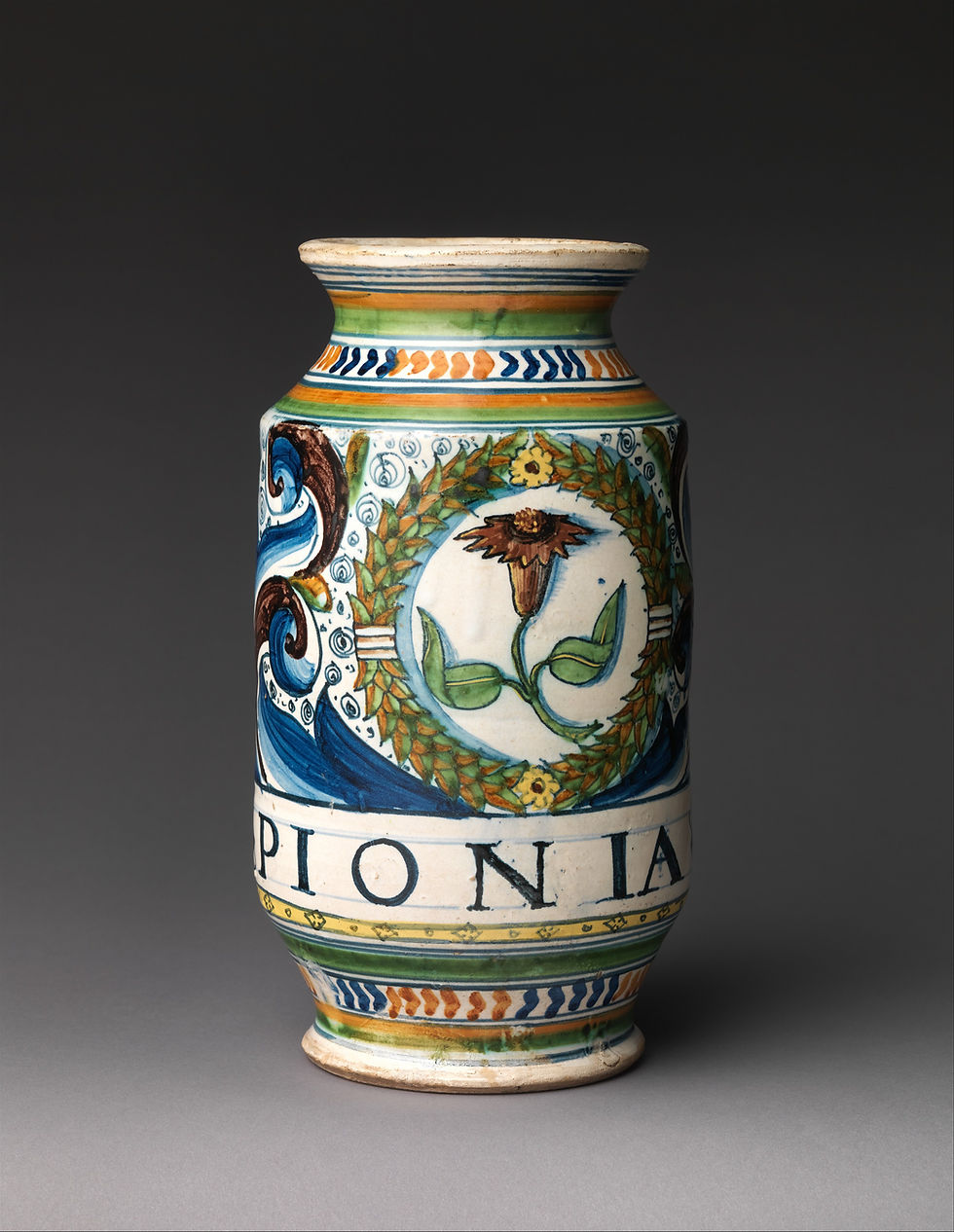
Pharmacy jar, Montelupo, ca. 1500–1510. The Metropolitan Museum of Art, Gift of J. Pierpont Morgan, by exchange, 1965 (65.6.4). CC0. Collection · CC0
Keep fragile, valuable or unusually heavy pieces out of casual styling experiments, and seek appropriate advice on supports or mounting where needed. Visual balance does not establish structural suitability. Once the placement is resolved, edit with restraint. Rotate a few objects when your attention changes instead of treating every available surface as space that must be filled.

Pharmacy jar, ca. 1530–60. The Metropolitan Museum of Art, Gift of George Blumenthal, 1941 (41.100.268). CC0. Collection · CC0
Sources
https://henry-moore.org/henry-moore-photography-and-scale/
https://www.canada.ca/en/conservation-institute/services/conservation-preservation-publications/canadian-conservation-institute-notes/care-ceramics-glass.html


Comments