The Most Beautiful Evening Gowns of Couture Week

Beauty, selected rather than declared
There is no universal measure for the most beautiful couture gown. Beauty depends on proportion, movement, context and the eye doing the looking. This selection is therefore deliberately editorial: it favors gowns in which construction creates emotion rather than simply rewarding expense, surface or spectacle.
Paris Haute Couture Week’s Fall/Winter 2026–2027 season ran from July 6 to July 9, 2026, according to the Fédération de la Haute Couture et de la Mode. Across those four days, the most persuasive evening propositions made a case for couture as architecture in motion. Their power emerged gradually—first through silhouette, then through movement, and finally through the private evidence of labor: the tension at a shoulder, the fall of embroidery, the engineering of a train.
The gowns selected here are not presented as an objective top tier. They are the looks and collections that most clearly turned technical decisions into feeling.
The gown as architecture
Eveningwear is often reduced to glamour, but couture begins with the body in space. A gown determines how its wearer occupies a room. It can elongate the figure, widen the shoulder, concentrate attention at the waist or make the body disappear inside volume.
That is why size alone is a poor measure of impact. A vast skirt may be inert; a narrow column may command an entire salon. The exceptional gown creates a relationship between the wearer and the surrounding architecture before embellishment enters the conversation.

In couture, construction is not hidden infrastructure. It is the source of presence. A corset, internal support, shaped seam or strategically weighted hem can determine the emotional character of the final image. What appears effortless may be the result of weeks of adjustment.
Standing Ground and the authority of restraint
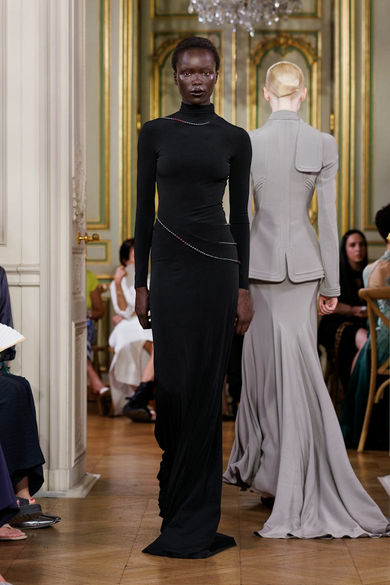
Standing Ground, the London label founded by Michael Stewart, made its Paris couture debut on July 6, 2026. The debut placed a young, made-to-order practice inside one of fashion’s most demanding institutional frameworks.
Stewart’s gowns treated the figure almost as a monument. Rather than relying on traditional gala excess, the collection used controlled draping, compressed volumes and close-to-the-body forms to make the body appear elongated, unfamiliar and deliberate. The surfaces were calm, but the construction remained exacting.
The beauty of the work came from refusing to fill every available space. In a season crowded with visual propositions, Standing Ground suggested that grandeur can be produced by subtraction. A single line, properly tensioned, can carry more authority than a dozen decorative effects.
The result was a kind of futuristic classicism: clothing that seemed ceremonial and stripped back at once. It asked the viewer to look twice, then longer.

Chanel and the poetry of lightness
Matthieu Blazy’s first Chanel haute couture collection, presented in Paris on January 27, 2026, offered a different model of grandeur. Rather than treating couture solely as ceremonial armor, Blazy returned to Gabrielle Chanel’s historic interest in clothing for work, cinema, theatre and ordinary life.
The collection’s evening looks were persuasive because their craft emerged slowly. Crystal-shimmered gowns appeared almost weightless, while sequins were paired with more relaxed elements. A column dress beneath a black satin opera coat created drama through contrast rather than volume alone.
Blazy’s approach was not a rejection of Chanel’s history. It was an attempt to remove some of its visual weight. Familiar codes—black, pearls, chain effects, controlled ease and the discipline of the suit—were made lighter, more tactile and less ceremonial.
The most beautiful Chanel propositions were therefore not necessarily the most ornate. Their authority came from the relationship between ease and precision: a lowered armhole, a controlled flare, a surface that caught light only when the wearer moved.

Surface that moves with the body
Couture embellishment is often treated as ornament, yet the finest surface treatment changes how a gown behaves. Beading creates drag. Feathers redirect movement. Sequins make a flat surface flicker. Thread can define the path of a seam or soften the edge of a structured form.
At Chanel, lightness allowed embellishment to move with the body rather than sit heavily on it. That difference is visible in photographs, but it is even more important in motion. A gown that remains static can look impressive in a front-facing image and disappointing when the wearer turns. A successful gown creates a changing image as it crosses a room.
This is where couture’s labor becomes emotional. The viewer may not know how a surface was assembled, but she can feel when it responds to the body rather than merely covering it.
Schiaparelli and body-conscious theatre

Schiaparelli approached the couture gown from the opposite direction. Under Daniel Roseberry, the house continues to treat fashion as visual theatre, drawing on anatomy, surrealism, sculptural jewelry and trompe-l’œil construction.

The Fall/Winter 2026 collection, presented on July 6 and titled “The Abyss,” explored fear of the deep ocean and a speculative future in which humans might merge with artificial intelligence. The concept was deliberately unsettling. Roseberry used marine references, synthetic materials and glossy surfaces to make the body appear both organic and engineered.
Such imagery could easily become costume. The strongest looks avoided that outcome by anchoring fantasy in the disciplined logic of a corset, seam, opening or engineered shoulder. A shell-like form had to remain a garment. A wave had to preserve posture. A surreal surface had to flatter the body beneath it.
Schiaparelli’s eveningwear understands the difference between an idea and an image. The idea may be a rib cage, a sea creature or a submerged world. The image must still move, hold its shape and survive the unforgiving conditions of public appearance.
Viktor&Rolf and the drama of excess
At Viktor&Rolf’s Fall/Winter 2026 couture presentation, titled “Gilded Age 2.0,” the designers used paired looks to examine the tension between opulence and austerity. The collection presented excess not as a simple virtue, but as a problem to be staged and interrogated.
That approach is central to Viktor&Rolf’s couture language. Volume, ornament and theatrical construction are pushed toward the point at which they become commentary. A gown may look lavish, but the exaggeration also asks what lavishness means in a period increasingly attentive to scarcity, inequality and ecological cost.

The most successful looks were those in which the theatrical impulse remained subordinate to silhouette. Opulence became legible because it was placed against restraint. Gold, surface and volume had force precisely because austerity was present as a counterargument.
The collection’s evening propositions were beautiful in the unstable sense: they attracted the eye while making the eye question its own appetite for spectacle.
The controlled train
The train remains one of eveningwear’s oldest devices, but contemporary couture is reconsidering what it can do. Rather than merely extending behind the wearer, a train can alter posture, dictate speed or create a second silhouette when viewed from the back.
The most persuasive examples this season attached trains to otherwise disciplined bodies. The contrast created tension. A long train is most effective when the front gives the eye something precise to understand: a defined waist, an exposed shoulder, a columnar line or an unusual neckline.
A train is not decoration trailing behind a gown. It is an instrument of choreography. It tells the wearer how to enter a room, when to pause and how to turn. It can make the body seem slower, more powerful or more vulnerable.
The back, the profile and the moving body

A red-carpet photograph privileges the front of a dress, but couture is designed in three dimensions. The profile reveals whether a skirt is genuinely sculptural or merely wide from one angle. The back exposes the train, closure, corsetry and relationship between shoulder and hip.
Still photography can therefore misrepresent a couture gown. A frontal image may flatten a garment designed to transform while walking; a dramatic back view may conceal an unusually restrained front. Proper judgment requires comparison: front, back, profile and movement.
This is also why attribution matters. The designer, collection, season and wearer should be identified before interpretation begins. A critic may argue that a gown feels mythological or fragile, but the record must remain exact.
From spectacle to emotional scale
The finest evening gowns create drama without exhausting the viewer. Some make the wearer appear powerful; others suggest fragility, romance, distance or myth. That range is what keeps couture alive.

Standing Ground’s monumental restraint, Chanel’s lightness, Schiaparelli’s surreal theatre and Viktor&Rolf’s critique of excess may seem unrelated. Yet all four approaches use construction to shape feeling. None depends on beauty as mere surface.
The most memorable gown is not necessarily the most embellished or photographed. It is the one in which fabric, proportion, embroidery, train and profile contribute to a single visual thought. Couture reaches its peak when workmanship disappears into emotion. The viewer does not leave thinking only about labor or expense. She leaves with the unsettling sense that the gown could not have been made any other way.
Sources and further reading


Comments