Katagami 如何让图案真正运作
日本纸型揭示了纺织图案如何为重复、染色以及服装方向的变化而被精密设计。
一条河可以在一块布上朝两个方向流动。The Metropolitan Museum of Art 收藏的一件19世纪日本纸型中,胡枝子聚集在蜿蜒溪流旁,但景观并不固定在单一的直立方向。博物馆解释了原因:没有肩缝的传统服装需要图案在正面与背面都能连贯阅读。这个细小的适应要求,正好帮助我们理解 katagami——用于纺织品图案制作的雕刻纸型。在这里,图像构图从一开始就在考虑服装结构。

Stencil for Textile with Pattern of Bush Clover and Meandering Stream, 19th century. The Metropolitan Museum of Art. Gift of Mrs. Horace Havemeyer, 1942. CC0 1.0. 藏品 · CC0 · 图像政策
来自 The Metropolitan Museum of Art 的十件历史纸型,以馆藏物件形式拍摄。这些图像展示的是工具本身,而不是当代染色示范。
保存下来的纸型是一件承担多重任务的工作工具。它必须让图案保持连接,让防染糊通过特定开口,同时还要让染匠能够在更大的表面上重复图案。平放在博物馆中时,它可能像一件独立的平面作品;真正的复杂性则出现在我们想象下一次定位、之后的染浴,以及布料围绕身体转动时。

Stencil, 19th century. Lattice-and-flower comparison. The Metropolitan Museum of Art. Gift of Mrs. Horace Havemeyer, 1942. CC0 1.0. 藏品 · CC0 · 图像政策
纸、糊与负空间
材料首先经历一种实用性的转化。Cooper Hewitt 介绍说,桑树皮纸经发酵柿汁处理后,会变得坚韧、柔韧并耐水。细丝线还能加固被切割的图案。这些支撑让制作者可以去除更多纸材,却不失去维系图案可用性的连接结构。可见图像与其支撑系统于是成为彼此独立又相互依存的两套组织。

Stencil, 19th century. Fine-line comparison; original paper and silk. The Metropolitan Museum of Art. Gift of Mrs. Horace Havemeyer, 1942. CC0 1.0. 藏品 · CC0 · 图像政策
这种分工在 The Met 的 Stencil with Pattern of Parallel, Undulating Lines 中尤其清楚;目录记载其为丝线加固的纸。线条通过重复制造运动感,而加固结构则支撑着一张越来越由“被切除之处”定义的纸。作为设计来阅读,这件物品提出一个异常精确的问题:要用多么少的可见结构,才能把复杂图像维持在原位?答案存在于材料本身,而不是依赖额外的装饰边框。

Stencil with Pattern of Parallel, Undulating Lines, 19th century. The Metropolitan Museum of Art. Gift of Mrs. Horace Havemeyer, 1942. CC0 1.0. 藏品 · CC0 · 图像政策

Stencil, 19th century. Separate fine-line-and-band comparison. The Metropolitan Museum of Art. Gift of Mrs. Horace Havemeyer, 1942. CC0 1.0. 藏品 · CC0 · 图像政策
要理解最终的纺织效果,观看者还必须反转一种直觉。Cooper Hewitt 对历史染坊的介绍描述了以木刮刀把米糊防染剂压过纸型。被覆盖的区域在染色过程中受到保护;纸型会沿布料反复移动。因此,开口实际决定了哪些地方不会被染色。纸型携带的是对未来图像的指令,其中也包括那些将保持未染的空间。
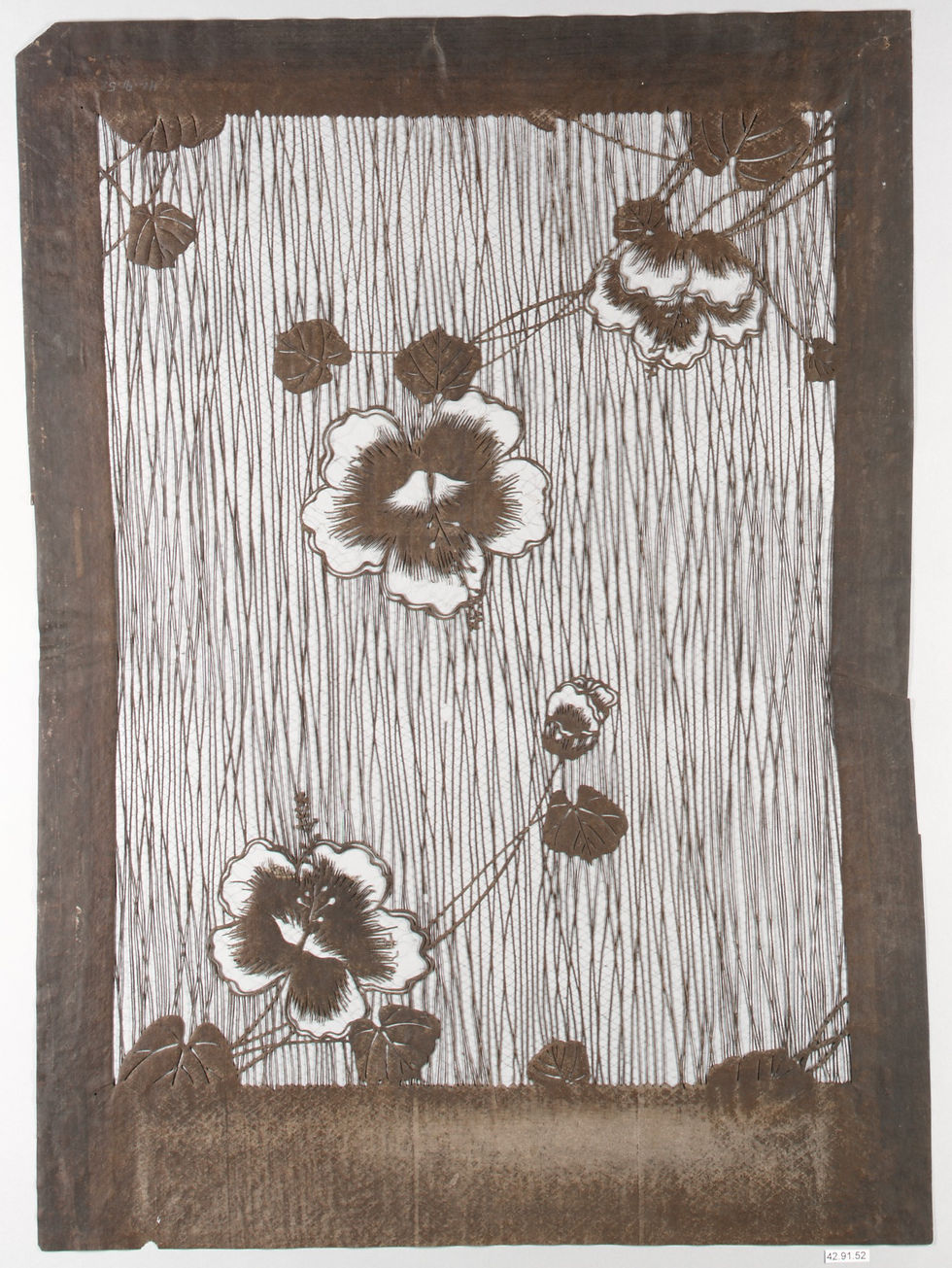
Stencil, 19th century. Flower-and-line comparison; a stencil, not finished cloth. The Metropolitan Museum of Art. Gift of Mrs. Horace Havemeyer, 1942. CC0 1.0. 藏品 · CC0 · 图像政策
必须能够移动的图案
The Met 的 Seascape on White Ground 让这种关系特别容易理解。馆藏记录将其识别为 jishiro,即“白地”:背景被切除,因此防染糊会保护背景,使染色图案出现在被保留的布地上。构图一半朝一个方向,另一半朝相反方向。海景被组织成一种可以从布料任一端进入观看的图案。它看似自由的装饰效果,其实依赖对翻转与使用方式的严格控制。

Stencil with Pattern of Seascape on White Ground, 19th century. The Metropolitan Museum of Art. Gift of Mrs. Horace Havemeyer, 1942. CC0 1.0. 藏品 · CC0 · 图像政策
重复也让不同类型的图像获得共同的工作格式。连续回纹 sayagata 形成互锁的几何场。The Met 将这一图案追溯至中国,并指出它在江户时期的日本服装中被广泛使用。另一件 Maple Leaves on Water 则援引龙田川及其与秋叶相关的诗意联想。一个设计通过几何连续性运作;另一个承载明确的季节意象。两者最终都必须成为能够重复的表面。

Stencil with Continuous Fret Pattern (sayagata), 19th century. The Metropolitan Museum of Art. Fletcher Fund, 1937. CC0 1.0. 藏品 · CC0 · 图像政策

Stencil with Pattern of Maple Leaves on Water, 19th century. The Metropolitan Museum of Art. Gift of Mrs. Horace Havemeyer, 1942. CC0 1.0. 藏品 · CC0 · 图像政策
对于今天观看这些纸型的设计师,更有用的类比是“重复单元的制作”,而不是完成后的布样。一条线在哪里离开边缘?下一次印制时什么会与它衔接?当布料折叠或改变方向时,哪些形状依然成立?这些是物件本身引发的分析问题,并不是说其制作者预见了数字设计。Katagami 用自己的历史方式回答这些问题:纸、线、切割以及染匠的手工操作。

Stencil with Pattern of Open Flowers on Water, 19th century. Related historical stencil; distinct from the 2013 peacock recreation. The Metropolitan Museum of Art. Gift of Mrs. Horace Havemeyer, 1942. CC0 1.0. 藏品 · CC0 · 图像政策
可重复使用工具中的工作量
劳动分工同样重要。2013 年 Cooper Hewitt 的一次示范中,雕刻师 Isao Uchida 根据馆藏重制了一件孔雀纸型,染匠 Masao Aida 则用它进行了纺织示范。博物馆报告说,Uchida 在活动前花了三天时间雕刻这一张纸型。即使只是一个重复单元,也可能在染色开始前凝聚大量准备工作。可重复使用性把劳动集中在工具之中,而工具的价值会在之后的一次次应用中展开。
Katagami 很适合在不同观看距离之间切换。从房间另一端看,我们读到波浪、花朵或细线场;靠近时,则会看到脆弱的连接桥与加固丝线,它们使这些视觉效果成为可能。服装尺度与纸张尺度必须一起理解。这些纸型提供了一段表面设计史,在其中,美感与制作顺序不可分割:制纸、切开口、定位重复单元、保留颜色,再让最终图案随着服装移动。
物件细节
来自 The Metropolitan Museum of Art 的十件历史纸型,以馆藏物件形式拍摄。这些图像展示的是工具本身,而不是当代染色示范。
1. Stencil for Textile with Pattern of Bush Clover and Meandering Stream, 19th century. Paper reinforced with silk. The Metropolitan Museum of Art, Gift of Mrs. Horace Havemeyer, 1942 (42.91.225). Image: The Metropolitan Museum of Art, CC0. CC0 许可。
2. Stencil with Pattern of Seascape on White Ground, 19th century. Paper, silk. The Metropolitan Museum of Art, Gift of Mrs. Horace Havemeyer, 1942 (42.91.16). Image: The Metropolitan Museum of Art, CC0. CC0 许可。
3. Stencil with Pattern of Maple Leaves on Water, 19th century. Paper reinforced with silk. The Metropolitan Museum of Art, Gift of Mrs. Horace Havemeyer, 1942 (42.91.14). Image: The Metropolitan Museum of Art, CC0. CC0 许可。
4. Stencil with Pattern of Parallel, Undulating Lines, 19th century. Paper reinforced with silk. The Metropolitan Museum of Art, Gift of Mrs. Horace Havemeyer, 1942 (42.91.188). Image: The Metropolitan Museum of Art, CC0. CC0 许可。
5. Stencil with Pattern of Open Flowers on Water, 19th century. Paper reinforced with silk. The Metropolitan Museum of Art, Gift of Mrs. Horace Havemeyer, 1942 (42.91.77). Image: The Metropolitan Museum of Art, CC0. CC0 许可。
6. Stencil with Continuous Fret Pattern (sayagata), 19th century. Paper. The Metropolitan Museum of Art, Fletcher Fund, 1937 (37.14.45). Image: The Metropolitan Museum of Art, CC0. CC0 许可。
7. Stencil, 19th century. Paper. The Metropolitan Museum of Art, Gift of Mrs. Horace Havemeyer, 1942 (42.91.194). Image: The Metropolitan Museum of Art, CC0. CC0 许可。
8. Stencil, 19th century. Paper, silk. The Metropolitan Museum of Art, Gift of Mrs. Horace Havemeyer, 1942 (42.91.213). Image: The Metropolitan Museum of Art, CC0. CC0 许可。
9. Stencil, 19th century. Paper, silk. The Metropolitan Museum of Art, Gift of Mrs. Horace Havemeyer, 1942 (42.91.52). Image: The Metropolitan Museum of Art, CC0. CC0 许可。
10. Stencil, 19th century. Paper, silk. The Metropolitan Museum of Art, Gift of Mrs. Horace Havemeyer, 1942 (42.91.184). Image: The Metropolitan Museum of Art, CC0. CC0 许可。


留言